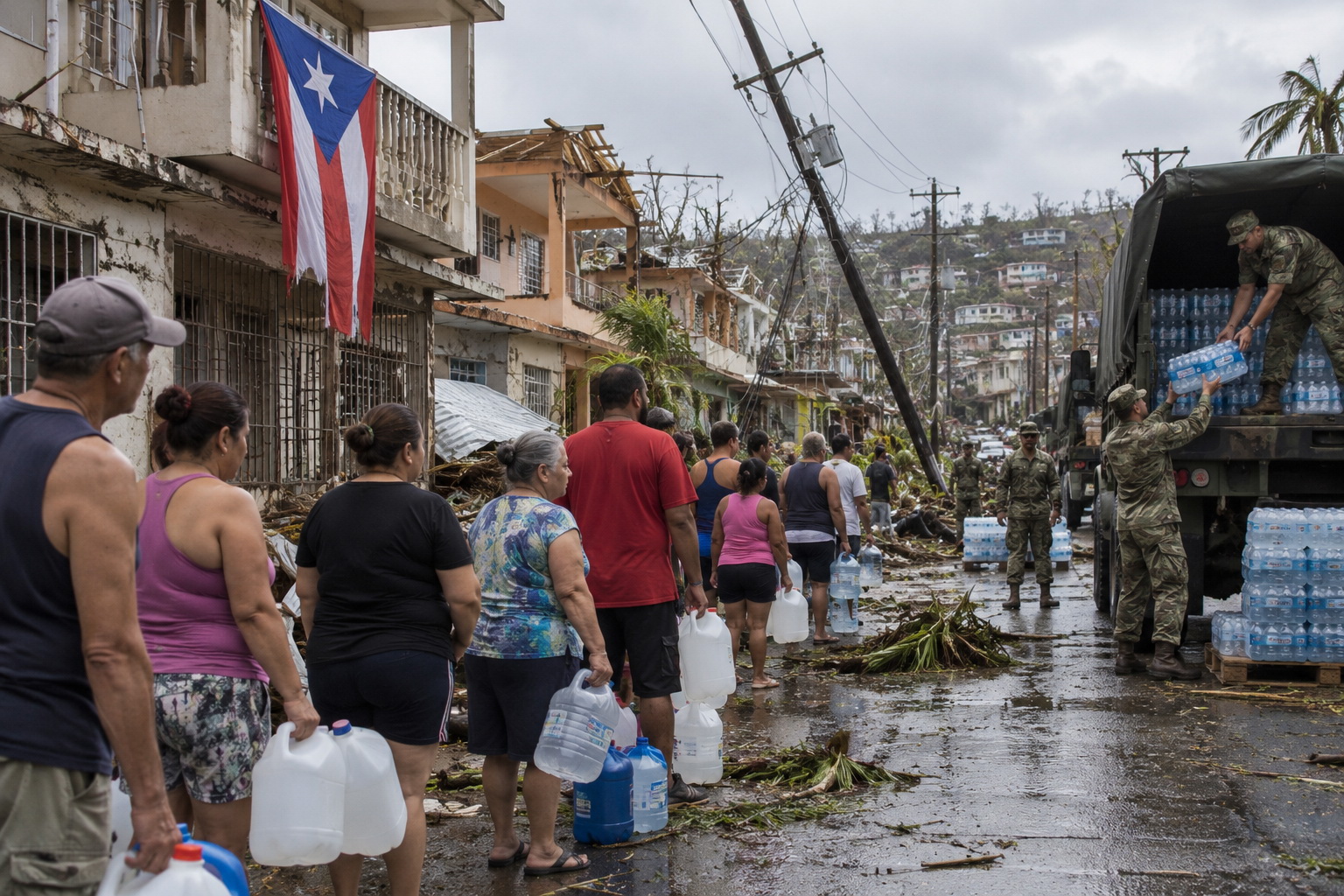
Nearly two weeks after Hurricane Maria devastated Puerto Rico, millions of American citizens were still struggling with widespread power outages, disrupted communications, damaged roads and shortages of basic necessities.
Yet as President Donald Trump prepared to visit the island, part of the national conversation had shifted away from the enormous logistical challenge of delivering aid.
The president was engaged in a public feud with the mayor of San Juan.
Mayor Carmen Yulín Cruz had become one of the most visible voices describing the desperation on the ground. After she publicly pleaded for additional federal assistance, Trump responded by attacking her leadership and accusing critics of his administration's disaster response of being politically motivated.
By October 2, the dispute had become so personal that Trump's upcoming visit raised the possibility that the president would come face-to-face with the mayor he had spent days criticizing.
Puerto Rico Was Still in Crisis
Hurricane Maria struck Puerto Rico on September 20 as a powerful Category 4 storm.
The hurricane devastated the island's electrical grid, damaged communications networks, flooded communities and made transportation across parts of Puerto Rico extremely difficult.
The problems were compounded by Puerto Rico's geography and infrastructure.
Unlike disaster relief operations in mainland states, supplies could not simply be moved into Puerto Rico by truck from neighboring states. Food, water, fuel, equipment and personnel had to arrive primarily by air or sea and then be distributed across an island where roads and communications had been severely damaged.
Federal agencies, the military, local officials, emergency workers and volunteers were carrying out a massive relief operation.
But many Puerto Ricans were still waiting for reliable access to electricity, drinking water and other essentials.
Cruz Pleads for Help
Cruz emerged as one of the most outspoken local officials during the crisis.
After acting Homeland Security Secretary Elaine Duke described the federal response as a “good news story” because of the government's ability to reach people, Cruz reacted angrily.
“This is, damn it, this is not a good news story,” she said during a September 29 appearance on CNN.
“This is a people-are-dying story.”
Cruz pleaded for federal officials to increase and better coordinate assistance.
“I am begging, begging anyone that can hear us to save us from dying,” she said.
Her comments received national attention.
They also drew the attention of the president.
Trump Attacks the Mayor
On September 30, Trump responded on Twitter.
Rather than limiting his comments to the government's relief operation, the president personally criticized Cruz.
He accused her of displaying “poor leadership ability” and claimed that Puerto Rican officials wanted “everything to be done for them.”
Trump also suggested that Cruz had been encouraged by Democrats to criticize him.
The remarks transformed a dispute about disaster relief into another political confrontation.
Trump continued defending the federal response over the weekend, praising FEMA, the military and first responders while dismissing some criticism as politically motivated.
Cruz, meanwhile, attempted to redirect attention toward the humanitarian situation.
“All I did last week, or even this week, was ask for help,” she said on October 1.
She also praised individual FEMA workers and administration officials who were assisting with recovery efforts.
A President Preparing to Visit the Disaster Zone
By October 2, Trump was preparing to travel to Puerto Rico the following day.
The timing made his confrontation with Cruz especially unusual.
Presidential visits following natural disasters traditionally emphasize reassurance, coordination with local officials and support for affected communities.
Trump was arriving after publicly attacking the mayor of the territory's largest city.
Cruz said she remained willing to meet with him.
“If he asks to meet with me, of course I would meet with him,” she said.
The president and mayor would indeed encounter one another during Trump's October 3 visit.
But the political dispute had already become inseparable from coverage of the hurricane response.
The Administration Defends Its Response
Trump and administration officials strongly rejected accusations that Puerto Rico had been neglected.
Federal agencies and the military had deployed thousands of personnel and delivered large quantities of food, water and emergency supplies.
Puerto Rico Gov. Ricardo Rosselló also publicly thanked the administration for federal assistance.
The scale of the challenge, however, was extraordinary.
Puerto Rico's electrical and communications systems had suffered catastrophic damage, and moving supplies from ports and distribution centers to isolated communities remained difficult.
The disagreement therefore wasn't simply over whether the federal government was responding.
It was over whether the response was sufficient for the magnitude of the disaster and whether assistance was reaching people quickly enough.
Cruz argued that it wasn't.
Trump insisted his administration was doing an extraordinary job.
A Humanitarian Crisis Becomes a Political Fight
The confrontation illustrated a recurring feature of Trump's presidency.
Criticism frequently became personal.
Instead of allowing administration officials and emergency-management agencies to answer questions about the response, Trump directly attacked one of the officials raising those questions.
That ensured that Cruz's criticism received even more national attention.
The mayor of San Juan, previously little known to most Americans outside Puerto Rico, suddenly became one of the country's most recognizable local politicians.
And a disaster-response debate became another confrontation involving the president.
What Came Next
Trump traveled to Puerto Rico on October 3.
During the visit, he repeatedly praised the federal response and compared the hurricane's then-official death toll favorably with Hurricane Katrina.
At one relief center, television cameras captured him tossing rolls of paper towels toward people gathered inside.
Those moments would become some of the most enduring images of his visit.
The true human cost of Hurricane Maria would also prove dramatically higher than the early numbers Trump cited.
Puerto Rico's government later adopted an official estimate of 2,975 excess deaths associated with the hurricane and its aftermath.
But on October 2, 2017, the full scale of that tragedy was not yet understood.
What was already clear was that Puerto Rico remained in a severe humanitarian crisis.
And on the eve of the president's visit, Donald Trump was spending part of his time publicly battling the mayor who had begged his government for more help.