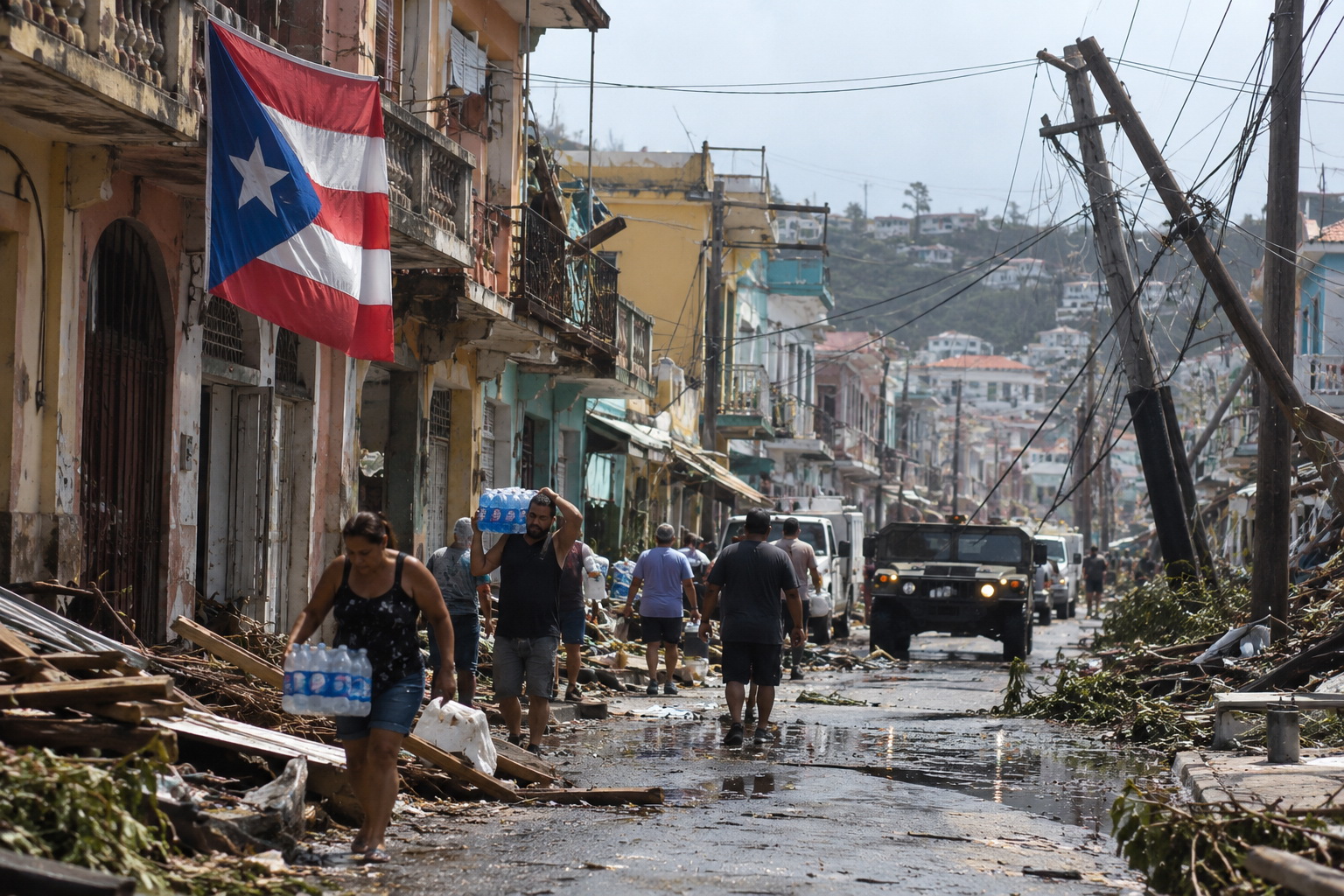
Nearly two weeks after Hurricane Maria devastated Puerto Rico, millions of American citizens were still struggling with widespread power outages, damaged roads, disrupted communications, and shortages of food, fuel and drinking water.
President Donald Trump, meanwhile, was engaged in an increasingly bitter public dispute with officials on the island who were pleading for more help.
On October 1, 2017, Trump defended his administration's disaster response while attacking critics as “politically motivated ingrates,” escalating a confrontation that had begun the previous day with San Juan Mayor Carmen Yulín Cruz.
The extraordinary exchange unfolded while Puerto Rico remained in the middle of a humanitarian emergency.
Hurricane Maria Devastates Puerto Rico
Hurricane Maria struck Puerto Rico on September 20 as a powerful Category 4 hurricane.
The storm devastated the island's electrical system, damaged homes and roads, disrupted communications and created enormous logistical problems for emergency responders.
Nearly two weeks later, most Puerto Ricans were still without electricity. Food and drinking water remained difficult to obtain in many communities, while damaged roads and communications systems complicated efforts to move supplies around the island.
The federal government had mounted a substantial response. FEMA, the military and other federal agencies deployed thousands of personnel, distributed supplies, provided generators and worked with Puerto Rican authorities.
But the scale of the catastrophe overwhelmed existing systems.
Later federal reviews would conclude that FEMA faced serious staffing and logistical difficulties. The agency was responding simultaneously to multiple major disasters, while Puerto Rico's location, damaged infrastructure and collapsed communications made the operation particularly difficult.
San Juan's Mayor Pleads for Help
As conditions remained desperate, San Juan Mayor Carmen Yulín Cruz became one of the most visible voices calling for additional federal assistance.
Cruz publicly pleaded for help and criticized the pace and coordination of the response.
Her comments came after acting Homeland Security Secretary Elaine Duke had described aspects of the federal response as a “good news story.”
Cruz strongly rejected that characterization.
She said people were suffering and dying and argued that the situation required a much more urgent response from Washington.
Trump responded personally.
Trump Attacks Cruz
On September 30, Trump accused Cruz of “poor leadership ability” and suggested that Puerto Rican officials wanted the federal government to do everything for them.
He also accused Democrats of encouraging criticism of his administration.
The following morning — October 1 — Trump continued defending the federal response.
“We have done a great job with the almost impossible situation in Puerto Rico,” Trump wrote.
He then dismissed some of those criticizing the response as “politically motivated ingrates.”
The comments drew additional attention because they came while the island remained badly damaged and residents were still struggling to obtain basic necessities.
Cruz largely declined to continue the personal fight.
“All I did last week, or even this week, was ask for help,” she said during a television interview that Sunday.
She said assistance needed to arrive quickly and consistently and indicated she was willing to meet with Trump when he visited Puerto Rico.
The Federal Response Was Enormous — And Deeply Challenged
The controversy surrounding Trump's comments sometimes obscured another reality: thousands of federal employees, military personnel and emergency workers were already working in Puerto Rico.
The operation eventually became one of the largest and longest disaster responses in FEMA's history.
But subsequent government investigations also documented significant problems.
The Government Accountability Office found that FEMA's workforce was stretched by the succession of major disasters in 2017. Puerto Rico's distance from the continental United States complicated transportation of personnel and supplies, while widespread destruction of the electrical grid and communications networks forced federal agencies to assume responsibilities normally handled by local authorities.
The electrical disaster proved particularly severe.
Puerto Rico ultimately experienced what the GAO described as the longest blackout in U.S. history, with full restoration to customers whose structures could safely receive power taking roughly 11 months.
The Death Toll Was Far Greater Than Initially Known
The human cost of Maria also proved far greater than officials understood during those first chaotic weeks.
Puerto Rico initially reported a comparatively small number of deaths directly attributed to the storm.
But the destruction of the electrical system, hospitals, transportation and communications made determining hurricane-related deaths extraordinarily difficult.
Puerto Rico later commissioned researchers at George Washington University to examine excess mortality following Maria.
The study estimated 2,975 excess deaths, a figure Puerto Rico adopted as its official hurricane death toll.
A Defining Moment of the Maria Response
Trump traveled to Puerto Rico two days later, on October 3.
But the confrontation with Cruz had already become one of the defining political moments of the disaster.
The dispute wasn't simply about whether federal assistance existed. Thousands of federal workers were on the island, and billions of dollars would eventually be committed to Puerto Rico's response and recovery.
The argument was about whether that response was moving fast enough for an island where millions of people had suddenly lost electricity, communications and access to essential services.
Instead of keeping the public focus entirely on those logistical challenges, the president of the United States entered into a personal fight with one of the officials asking Washington for additional help.
On October 1, 2017, Puerto Rico was still struggling to recover from one of the most destructive hurricanes in its history.
And America's president was publicly fighting with some of the people trying to lead it through the disaster.