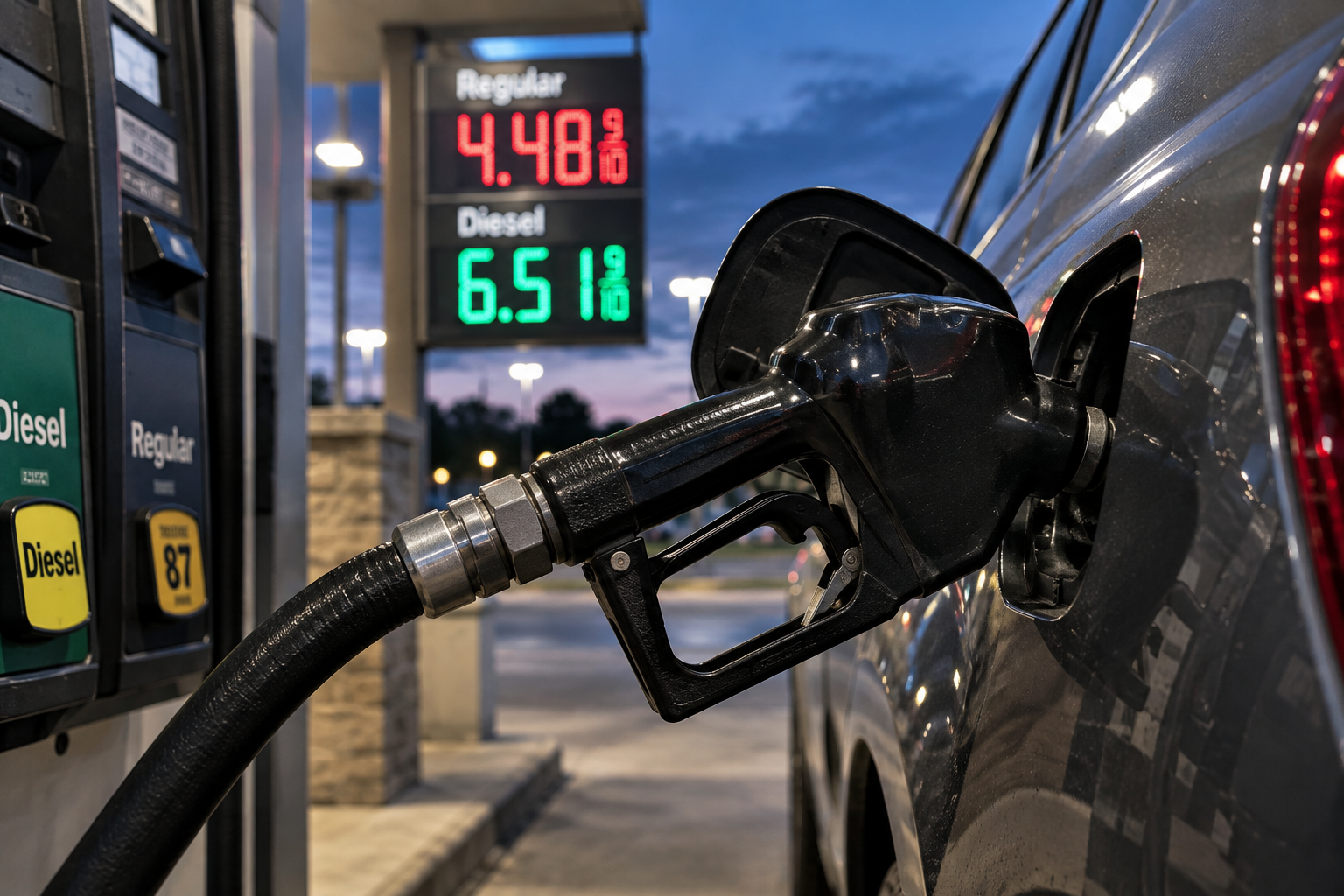
The economic consequences of the war with Iran are increasingly showing up on gas-station signs across America, with gasoline climbing sharply and diesel reaching a record national average.**
As of September 20, AAA reports that regular gasoline averages approximately $4.48 per gallon nationwide, compared with about $3.19 one year ago.
Diesel has climbed even more dramatically.
The national average has reached approximately $6.51 per gallon — the highest nominal price AAA has recorded. A year ago, diesel averaged about $3.70.
In California, the numbers are considerably higher.
Regular gasoline currently averages approximately $6.15 per gallon, while diesel has reached approximately $8.42 per gallon.
The increases are not simply an unexplained fluctuation in gasoline prices. The war between the United States and Iran has significantly disrupted the global petroleum market and the routes used to transport oil out of the Middle East.
From $2.98 Gas to More Than $4
Before the U.S. and Israel attacked Iran in late February, the national average for regular gasoline stood at approximately $2.98 per gallon, according to figures cited by the Associated Press.
Diesel was approximately $3.76 per gallon.
Seven months later, gasoline is approaching $4.50 nationally and diesel has surpassed $6.50.
The connection between the conflict and fuel prices begins thousands of miles from American gas stations, at one of the most important waterways in the global economy: the Strait of Hormuz.
Before the war, roughly one-fifth of the world's petroleum passed through the strait.
Fighting involving the United States, Iran and Iranian-aligned forces has severely disrupted those energy flows.
The U.S. Energy Information Administration reported this month that global petroleum inventories have fallen by roughly 400 million barrels during 2026, while millions of barrels per day of Middle Eastern production and exports have been taken offline.
The agency specifically cited lost Middle Eastern supply associated with the ongoing Iran conflict when it raised its forecasts for oil prices.
Oil Back Above $100
The effects are readily visible in the crude-oil market.
Brent crude, the international benchmark, recently climbed back above $100 per barrel as fighting intensified.
On September 18, Brent settled at approximately $104.87 per barrel, while U.S. West Texas Intermediate crude settled at $100.30.
The conflict has also spread beyond Iran itself.
Attacks and military activity have threatened Saudi energy infrastructure and shipping through the Bab el-Mandeb, another strategically important route for global petroleum supplies.
Meanwhile, the Strait of Hormuz remains severely restricted.
Reuters reported that only four commodity vessels passed through the strait on September 17.
That combination — constrained shipping, reduced Middle Eastern production, attacks on energy infrastructure and uncertainty about when the conflict will end — has helped keep crude oil and refined fuels expensive.
Diesel May Hurt Far Beyond the Gas Station
For American consumers, diesel may ultimately prove even more consequential than gasoline.
Diesel powers much of the nation's commercial transportation system.
Tractor-trailers use it to move products across the country. Farmers use it to operate equipment. Trains, construction machinery and delivery fleets depend upon it.
That means a diesel price of more than $6.50 doesn't affect only people who own diesel-powered vehicles.
Transportation expenses become part of the cost of moving groceries, building materials, manufactured goods and countless other products.
Those expenses can eventually be passed along to consumers.
The Associated Press reported that some businesses have already added fees to deliveries and shipments as transportation expenses increase.
Food is particularly vulnerable because meat, produce and other perishable products must constantly move through refrigerated transportation and distribution networks.
Trump Acknowledges the War Has Driven Energy Prices Higher
President Donald Trump himself has acknowledged that the Iran conflict has contributed to higher energy prices.
Speaking earlier this month, Trump said he did not expect oil prices to decline substantially until after the November midterm elections.
The president also acknowledged that the conflict had caused energy prices to rise and financial markets to struggle, while arguing that the military campaign was necessary to prevent Iran from obtaining a nuclear weapon.
The administration has attempted to limit the economic damage, including drawing down the Strategic Petroleum Reserve.
But the underlying problem remains difficult for Washington to control.
As long as significant amounts of Middle Eastern petroleum production remain offline and major shipping routes remain disrupted, additional American oil production alone cannot immediately replace every barrel or restore the global transportation network.
The War Isn't the Only Factor
Not every penny of today's gasoline and diesel prices can be attributed exclusively to Iran.
Refinery capacity constraints have also contributed to elevated prices for finished fuels. Disruptions involving Russian refining capacity have added pressure to global diesel markets.
In California, state taxes, environmental requirements, the state's specialized gasoline blend and its relatively isolated refining market contribute to prices that are substantially higher than the national average.
But the dramatic national increase since February has coincided with — and has been substantially driven by — the disruption of Middle Eastern oil production and transportation resulting from the Iran war.
The numbers show the scale of the change.
Before the conflict, regular gasoline averaged about $2.98 per gallon nationally.
Today it is approximately $4.48.
Diesel has moved from roughly $3.76 to $6.51.
And in California, drivers buying diesel are now paying an average of more than $8.42 per gallon.
Whatever happens next on the battlefield, one consequence of the conflict is already reaching Americans thousands of miles away.
It is displayed in enormous numbers on gas-station signs across the country.