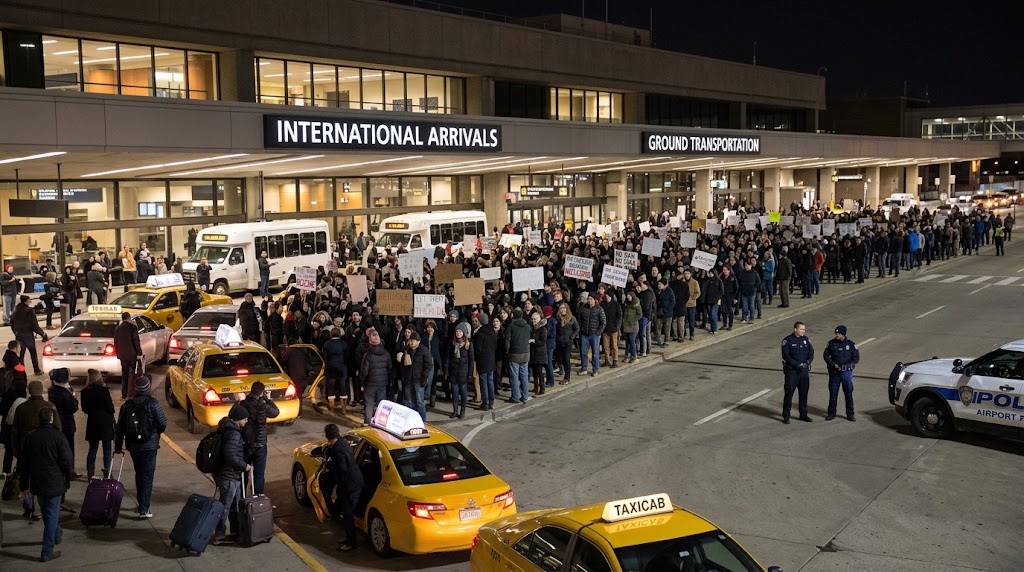
Within hours of President Donald Trump's new travel restrictions taking effect, America's international airports became the center of a rapidly expanding political and legal confrontation.
Travelers were being detained.
Families waited for relatives who had been expected to walk through international arrivals.
Attorneys rushed to airports to determine who was being held.
And crowds of protesters gathered to oppose the new restrictions.
The executive order had been signed only the previous afternoon.
By Saturday, January 28, its consequences were playing out publicly inside airport terminals.
The First Travelers Encounter the New Rules
Trump's January 27 executive order temporarily restricted entry for many nationals of Iran, Iraq, Libya, Somalia, Sudan, Syria and Yemen.
It also suspended the U.S. refugee admissions program for 120 days and suspended Syrian refugee admissions indefinitely.
Because the order took effect immediately, some people were already traveling when the rules changed.
Among them was Hameed Khalid Darweesh, an Iraqi who had worked with the U.S. government and received a Special Immigrant Visa.
Darweesh arrived at John F. Kennedy International Airport in New York and was detained by U.S. Customs and Border Protection.
Another Iraqi traveler, Haider Sameer Abdulkhaleq Alshawi, was also detained at JFK.
Their cases would quickly move from the airport terminal into federal court.
Lawyers Arrive at JFK
Attorneys went to JFK attempting to determine who had been detained and whether they could speak with them.
According to the federal complaint subsequently filed in the case, attorneys attempting to reach Darweesh were unable to meet with him while he was being held.
The situation was moving extraordinarily quickly.
An executive order signed in Washington was now being interpreted and enforced by immigration officials dealing with individual travelers arriving from overseas.
Lawyers began preparing an emergency legal challenge.
Protesters Fill Airport Terminals
At the same time, opposition to the order was becoming visible.
Demonstrators gathered at airports demanding that detained travelers be released and that affected immigrants and refugees be allowed into the country.
Handmade signs appeared throughout arrival terminals.
Chants echoed through airport corridors.
Travelers pushing luggage through terminals suddenly found themselves walking through demonstrations over a presidential order signed less than 24 hours earlier.
The airports had become the most visible front line of the dispute.
The Fight Moves Into Federal Court
On the morning of January 28, civil-rights and immigration attorneys filed Darweesh v. Trump in federal court in New York.
The lawsuit challenged the detention of Darweesh and Alshawi and sought protection for similarly situated travelers affected by the executive order.
The legal battle unfolded rapidly.
That evening, U.S. District Judge Ann Donnelly issued an emergency stay preventing the government from removing certain people who had arrived in the United States and were affected by the order.
The ruling did not eliminate Trump's executive order.
But it placed an immediate judicial restriction on part of its enforcement.
Barely a day after the president signed the order, a federal court had intervened.
The Administration Defends Its Policy
The Trump administration maintained that the restrictions were necessary while the government reviewed immigration and refugee screening procedures.
The executive order framed the policy as a national-security measure intended to prevent people who might pose a threat from entering the United States.
Opponents argued that the order was discriminatory and that its rapid implementation had improperly trapped travelers who had already received authorization to enter the country.
Those competing arguments would continue through months of litigation.
But on January 28, the immediate dispute was occurring person by person at America's airports.
A Presidency Meets Organized Opposition
The airport demonstrations were among the first large, spontaneous public reactions to a specific policy of the new administration.
The response was not limited to street demonstrations or political speeches.
Protesters gathered in terminals.
Volunteer attorneys offered legal assistance.
Civil-rights organizations filed lawsuits.
Federal judges were asked to intervene.
Families waited for answers.
Immigration officials attempted to implement a newly issued presidential directive.
All of it happened within hours.
From Executive Order to National Confrontation
The events of January 28 demonstrated how quickly a presidential decision could move through the institutions of American government and society.
The president had exercised executive authority.
Federal agencies began enforcing the order.
Citizens assembled to protest it.
Attorneys challenged it.
And the judiciary began reviewing it.
The larger legal battle over Trump's immigration policies was only beginning.
But by the end of January 28, the controversy surrounding the travel restrictions had already moved far beyond the White House.
It was unfolding in airport terminals and federal courtrooms across the country.