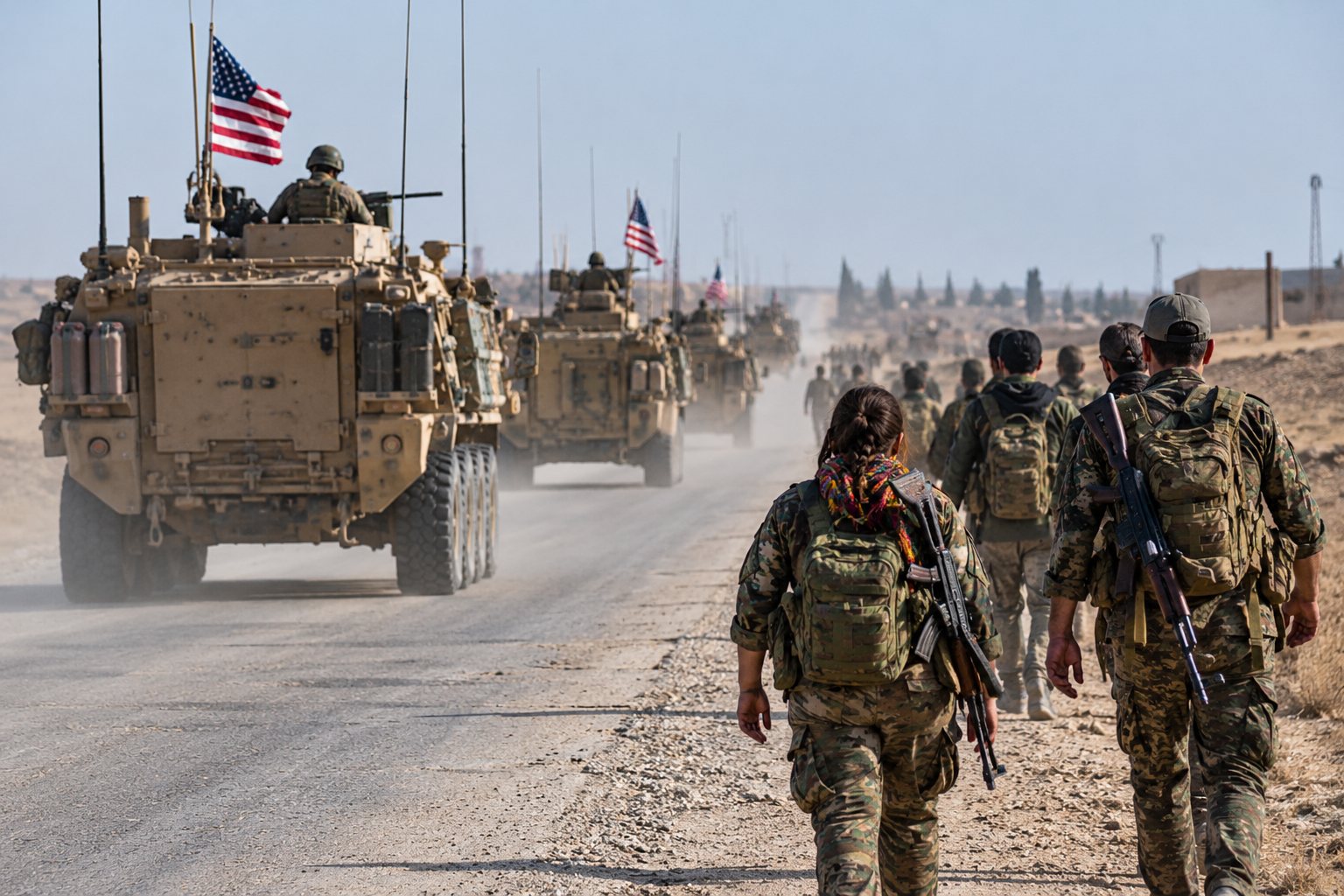
Just over a week after President Donald Trump abruptly announced that U.S. forces would move away from part of the Syrian-Turkish border, Turkey had launched a military offensive into northeastern Syria against Kurdish-led forces that had fought alongside the United States against ISIS. Now Trump was trying to stop the consequences. He imposed sanctions on Turkish officials and ministries, moved to raise tariffs on Turkish steel to 50 percent, halted negotiations on a $100 billion trade agreement and demanded an immediate ceasefire. Trump's own executive order acknowledged that Turkey's offensive endangered civilians and undermined the campaign to defeat ISIS.**
Eight days earlier, the White House had announced a dramatic change in American policy in northern Syria.
On October 6, following a phone conversation between Donald Trump and Turkish President Recep Tayyip Erdoğan, the White House announced that U.S. troops would no longer remain in the immediate area of Turkey's planned operation in northeastern Syria.
Turkey had long wanted to attack Kurdish forces operating along its southern border.
Those Kurdish fighters were closely associated with the Syrian Democratic Forces, or SDF.
And the SDF had been one of America's most important partners in the ground war against ISIS.
For years, American troops had worked alongside Kurdish-led forces.
Their presence also served as a significant deterrent against a Turkish offensive into areas controlled by the SDF.
Then the Americans moved aside.
Three days later, Turkey attacked.
Turkey Launches Operation Peace Spring
On October 9, Turkish forces began their offensive into northeastern Syria.
Turkey called it Operation Peace Spring.
Erdoğan's government viewed the Kurdish YPG militia, a major component of the SDF, as connected to the Kurdistan Workers' Party, or PKK, which Turkey and the United States designate as a terrorist organization.
Turkey argued that Kurdish-controlled territory along its border represented a national security threat.
But the Kurdish-led SDF had also provided much of the ground combat power for the U.S.-led campaign against ISIS in Syria.
Thousands of Kurdish fighters had been killed during that campaign.
Now they were under attack by Turkey, a NATO member.
And the United States was withdrawing.
Republicans Turn Against Trump
The decision produced unusually intense criticism from members of Trump's own party.
Republican lawmakers who normally supported the president warned that abandoning the Kurds could damage American credibility and potentially allow ISIS to regroup.
Senate Majority Leader Mitch McConnell publicly urged Trump to reverse course.
Sen. Lindsey Graham called the decision a disaster.
Other Republicans warned that American allies around the world would notice what happened when Kurdish forces that had fought beside the United States suddenly found themselves facing Turkey largely on their own.
Trump defended his decision.
He argued that the United States had been involved in Middle Eastern conflicts for too long.
He repeatedly said it was time to bring American troops home.
But the situation on the ground deteriorated rapidly.
Civilians Flee
Turkey's offensive produced fighting across northern Syria and displaced large numbers of civilians.
Humanitarian organizations warned about the growing crisis.
There were also concerns about ISIS prisoners being held in facilities guarded by Kurdish forces.
The SDF had been responsible for guarding thousands of captured ISIS fighters and tens of thousands of associated family members.
But Kurdish forces now had another immediate priority:
Defending themselves from Turkey.
Defense Secretary Mark Esper acknowledged the danger on October 14.
Turkey's invasion, he said, had produced “widespread casualties, refugees, destruction, insecurity, and a growing threat to U.S. military forces.”
Esper also said the offensive had undermined the multinational campaign against ISIS and had resulted in the release of ISIS detainees.
The administration was now publicly describing consequences it had feared only days after Trump's troop decision.
Then Trump Sanctioned Turkey
On October 14, Trump changed tactics.
He signed an executive order authorizing sanctions against Turkey.
The Treasury Department immediately sanctioned Turkey's Ministry of National Defence and Ministry of Energy and Natural Resources.
Three senior Turkish officials were also sanctioned:
The ministers of defense, interior and energy.
Trump announced that tariffs on Turkish steel would be increased back to 50 percent.
He halted negotiations over a proposed $100 billion U.S.-Turkey trade agreement.
And he threatened much more.
“I am fully prepared to swiftly destroy Turkey's economy if Turkish leaders continue down this dangerous and destructive path,” Trump said.
The United States was now economically punishing Turkey for continuing an offensive that had begun after American troops were moved away from its path.
Trump's Own Executive Order Described the Danger
The language of Trump's executive order was particularly striking.
The president formally declared that Turkey's military offensive:
“undermines the campaign to defeat the Islamic State of Iraq and Syria, or ISIS.”
It also:
“endangers civilians.”
And it threatened:
“the peace, security, and stability in the region.”
Those weren't accusations coming from Trump's political opponents.
They appeared in an executive order signed by Donald Trump.
His administration was acknowledging that Turkey's offensive endangered civilians and threatened the fight against ISIS.
Trump Demands a Ceasefire
Trump also spoke directly with Erdoğan on October 14.
Vice President Mike Pence said Trump told the Turkish president that the United States wanted Turkey to stop the invasion and implement an immediate ceasefire.
Pence announced that he and National Security Adviser Robert O'Brien would travel to Turkey to negotiate.
“The United States of America is simply not going to tolerate Turkey's invasion in Syria any longer,” Pence said.
That created an extraordinary sequence of events.
October 6: Trump announces that American forces will move away from Turkey's planned operation.
October 9: Turkey launches its offensive.
October 14: Trump demands that Turkey stop and imposes sanctions.
Only eight days separated the first decision from the sanctions.
Trump Insisted He Hadn't Given Turkey a Green Light
The administration strongly rejected accusations that Trump had authorized the invasion.
Pence insisted that the United States had not given Turkey a “green light.”
Turkey was responsible for its own military decision.
That distinction matters.
Trump did not order Turkey to invade Syria.
Erdoğan did.
But Trump's decision changed the military situation along the border.
The small number of American troops there had provided something much larger than their numbers suggested.
Their presence meant that a Turkish attack risked hitting U.S. personnel and potentially creating a direct confrontation with the United States.
Once those forces were moved away from the border, that obstacle was diminished.
Turkey attacked days later.
The Kurds Turn to Assad
The consequences extended beyond Turkey and the Kurds.
Facing a much larger Turkish military, Kurdish leaders sought help elsewhere.
They reached an agreement with the Syrian government of Bashar al-Assad.
Syrian government troops began moving into territory previously controlled by Kurdish forces.
That meant territory where American influence had been significant was increasingly opening to Assad and his allies.
Those allies included Russia and Iran.
The geopolitical balance in northern Syria was shifting rapidly.
ISIS Was Still a Concern
Trump repeatedly emphasized that ISIS had lost its territorial caliphate during his presidency.
That was true.
The last significant ISIS-held territory in Syria had fallen earlier in 2019.
But destroying ISIS's territorial state wasn't the same thing as eliminating ISIS.
Thousands of fighters remained imprisoned.
Others remained active underground.
American military officials had warned that the organization could regenerate if pressure disappeared.
Now Trump's own administration was saying Turkey's offensive was undermining the campaign against ISIS.
Defense Secretary Esper explicitly warned of “a potential ISIS resurgence.”
A Crisis the Administration Was Trying to Contain
By October 14, the Trump administration was simultaneously doing two things.
It was continuing the withdrawal of American forces from northeastern Syria.
And it was trying to stop the Turkish offensive that followed the change in the U.S. military posture.
Economic sanctions became the substitute for the military deterrent that had existed along portions of the border.
Trump threatened Turkey's economy.
Pence prepared to travel to Ankara.
American diplomats pushed for negotiations.
And the president demanded a ceasefire.
Three Days Later
On October 17, Pence met with Erdoğan in Ankara.
The United States and Turkey announced an agreement under which Turkey would pause its offensive for 120 hours while Kurdish YPG forces withdrew from a designated border area.
The Trump administration agreed not to impose additional sanctions during the pause and said existing sanctions would be lifted once the operation was halted.
On October 23, Trump announced that Turkey had agreed to make the ceasefire permanent and ordered the October 14 sanctions lifted.
The sanctions had lasted barely more than a week.
The Sequence Matters
Trump had every right as president to reconsider America's military presence in Syria.
There were legitimate arguments over how long U.S. troops should remain there and what American objectives should be.
Turkey also had its own security concerns regarding Kurdish militant groups along its border.
But the chronology of October 2019 is difficult to separate from the consequences that followed.
American troops were moved away from Turkey's planned operation.
Turkey attacked the Kurdish-led forces that had helped the United States fight ISIS.
Civilians fled.
Concerns grew about ISIS detainees.
Kurdish leaders turned toward Assad for protection.
The Trump administration warned that the offensive was undermining the fight against ISIS.
And eight days after announcing the change in America's military posture, Donald Trump was threatening to destroy Turkey's economy unless Erdoğan stopped.
Trump's own executive order summarized the situation plainly.
Turkey's offensive “endangers civilians” and “undermines the campaign to defeat” ISIS.
The United States had spent years fighting alongside Kurdish forces against the Islamic State.
In October 2019, those allies suddenly found themselves facing another American ally.
And Washington was scrambling to contain a crisis that had dramatically escalated in a matter of days.