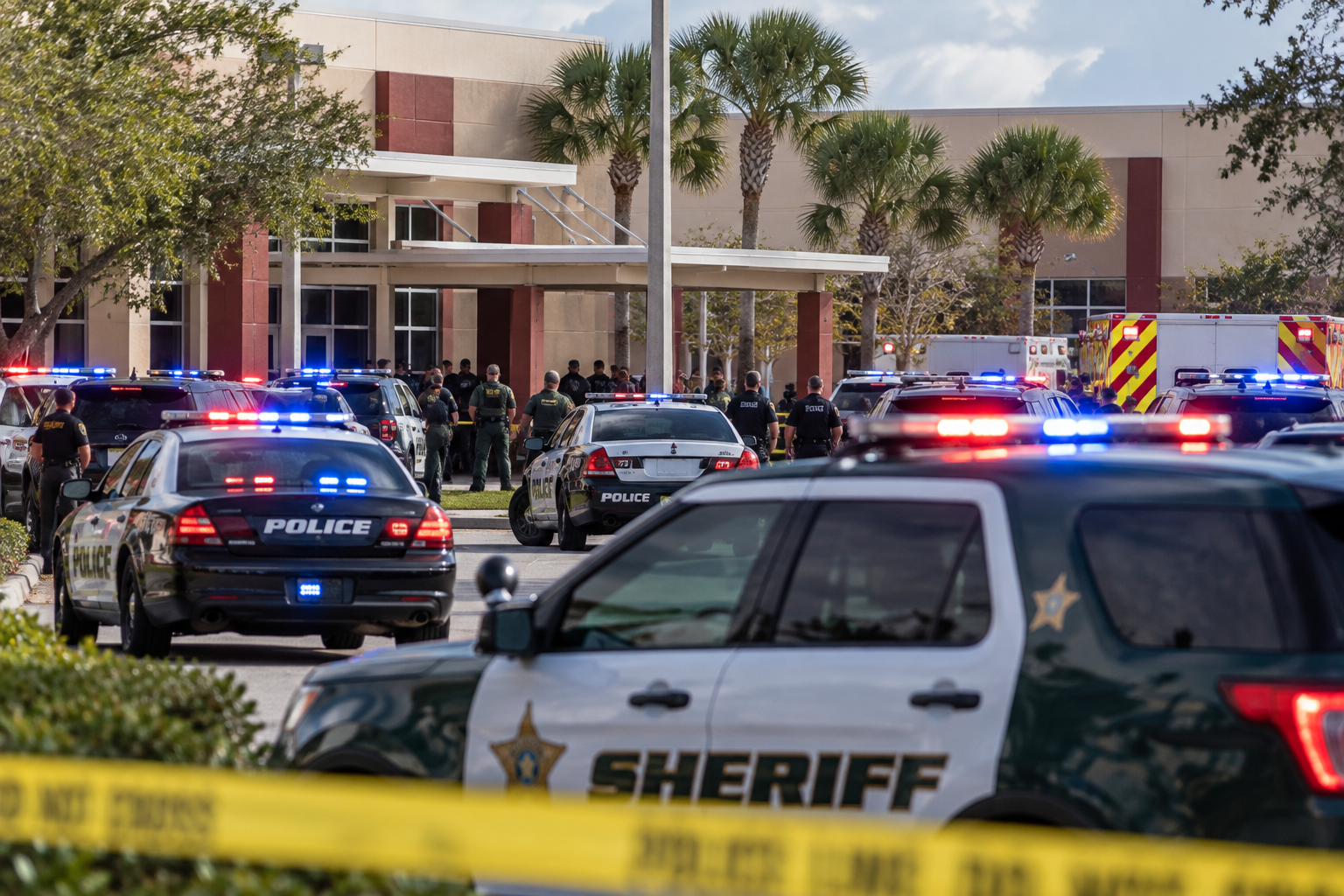
One week after 17 people were murdered at Marjory Stoneman Douglas High School in Parkland, Florida, President Donald Trump proposed one of the most controversial responses to the massacre:
Put guns in the hands of some teachers.
Trump argued that specially trained teachers, coaches and other school employees carrying concealed firearms could confront a shooter before police arrived.
He suggested perhaps 10 to 20 percent of school personnel could be armed.
He proposed giving participating teachers additional firearms training.
He even suggested paying them bonuses for carrying guns.
In Trump's view, the possibility that armed educators were inside a school would deter potential attackers.
“If you had a teacher who was adept at firearms,” Trump said, that teacher “could very well end the attack very quickly.”
The proposal immediately ignited a national argument over what Americans should expect teachers to do when they walk into a classroom.
Teach children?
Or potentially engage an active shooter in a gunfight?
Seventeen People Murdered at Parkland
On February 14, 2018, a gunman entered Marjory Stoneman Douglas High School in Parkland, Florida, carrying an AR-15-style semiautomatic rifle.
Within minutes, 17 students and staff members were dead.
Fourteen others were wounded.
The massacre horrified the country and created another national debate over guns, school security and America's repeated inability to prevent mass shootings.
The following day, Trump addressed the nation.
He called the shooting an act of “terrible violence, hatred, and evil.”
“To every parent, teacher, and child who is hurting so badly,” Trump said, “we are here for you.”
But during the days that followed, attention shifted from mourning the victims to determining what the federal government intended to do.
And Trump increasingly focused on one particular idea.
Armed educators.
Trump Meets With Students and Families
On February 21, Trump hosted students, parents and educators at the White House for an emotional listening session on school violence.
Some participants had survived the Parkland shooting.
Others had lost children in previous school massacres.
During the discussion, Trump raised the possibility of allowing specially trained teachers to carry concealed firearms.
He pointed specifically to Aaron Feis, an assistant football coach and security guard at Marjory Stoneman Douglas who was killed while protecting students.
Trump argued that if Feis had possessed a firearm, the outcome might have been different.
“If the coach had a firearm in his locker when he ran at this guy,” Trump said, “he wouldn't have had to run; he would have shot and that would have been the end of it.”
Trump then expanded the idea.
He suggested that approximately 20 percent of the teaching force might potentially carry concealed weapons if those individuals were particularly skilled with firearms and received additional training.
Trump Wasn't Proposing Guns for Every Teacher
Trump's proposal was frequently summarized as “arming teachers.”
That description was broadly accurate but incomplete.
Trump repeatedly emphasized that he did not want every teacher carrying a firearm.
He envisioned a smaller group of educators and other employees who already had substantial firearms experience.
“I don't want teachers to have guns,” Trump later clarified.
Instead, he said he wanted “highly trained people” who possessed a natural aptitude for firearms.
Trump mentioned teachers.
He mentioned coaches.
He mentioned military veterans who later became educators.
He mentioned other school employees.
He proposed concealed carry rather than teachers openly wearing firearms in classrooms.
And he insisted participants would undergo substantial training.
Trump's argument was essentially that schools already contained people capable of becoming an immediate armed response force.
Rather than waiting for police to arrive, those employees could confront an attacker themselves.
The Twenty Percent Proposal
Trump repeatedly discussed the possibility that somewhere around 10 to 20 percent of school personnel could be armed.
At another White House meeting on February 22, Trump suggested the number could vary considerably.
“It may be 10 percent or it may be 40 percent,” he said.
But his most frequently cited figure was approximately 20 percent.
Trump believed the knowledge that armed personnel might be present would itself discourage school shootings.
Under his proposal, the firearms would be concealed.
Potential attackers therefore wouldn't know which teachers or employees were armed.
Trump argued that this uncertainty would transform schools from “gun-free zones” into what he called “hardened targets.”
Trump Suggests Paying Armed Teachers More
Trump also proposed financial incentives.
Teachers and other employees who underwent firearms training and agreed to carry weapons could receive additional compensation.
“I would actually give a bonus to every coach, teacher, et cetera,” Trump said.
He envisioned extensive initial training followed by additional firearms instruction every year.
Trump also argued that the system would cost considerably less than hiring enough professional armed security officers to protect large schools.
That revealed another dimension of the proposal.
Instead of creating a separate security force, existing school employees could perform both roles.
A teacher might teach algebra during one period and potentially serve as an armed responder during an emergency.
For Trump, that represented an efficient way to protect schools.
For many educators, it represented an entirely different profession being added to theirs.
Teachers Push Back
The reaction from major teacher organizations was immediate.
The National Education Association said parents and educators overwhelmingly rejected the idea of arming school employees.
“Educators need to be focused on teaching our students,” NEA President Lily Eskelsen García said.
The American Federation of Teachers offered a similar response.
AFT President Randi Weingarten said she had spoken with approximately 60,000 educators during a telephone town hall.
According to Weingarten, the response was overwhelming — including among teachers who themselves owned firearms.
“Teachers don't want to be armed,” she said.
“We want to teach.”
That distinction went to the heart of the controversy.
Teaching and Armed Security Are Different Jobs
Trump's proposal assumed that a teacher who was comfortable with firearms could be trained to respond effectively during a school shooting.
But carrying a firearm recreationally or possessing a concealed-carry permit isn't the same thing as responding to an active shooter inside a crowded school.
Teachers are trained primarily in education.
They manage classrooms.
They teach mathematics, science, English and history.
They recognize learning disabilities.
They resolve conflicts between students.
They communicate with parents.
They protect children during emergencies.
None of those responsibilities inherently provides the tactical training required to identify and engage an armed attacker in a chaotic building filled with frightened children.
Trump acknowledged part of that problem himself.
He repeatedly said participating teachers would require significant additional training.
But that raised another question:
If extensive tactical and firearms training was necessary, why transform teachers into security personnel rather than employ trained security professionals specifically for that purpose?
What Happens When Police Arrive?
The proposal also raised difficult practical questions.
An active-shooter scene is chaotic.
Students are running.
Teachers are trying to secure classrooms.
Police officers are entering a building knowing someone inside possesses a firearm.
Now imagine multiple armed teachers moving through that same building.
How would responding officers immediately distinguish an armed teacher from the attacker?
Where would firearms be stored?
Would teachers carry them throughout the school day?
What happens during a physical confrontation between students?
What happens if a student obtains access to an educator's weapon?
How frequently would armed teachers have to qualify with their firearms?
Who would determine whether an educator was psychologically and tactically prepared to shoot another person?
These weren't theoretical details.
They were basic questions that any nationwide armed-teacher policy would eventually have to answer.
Trump Says Teachers Would Protect Students Because They Love Them
Trump made another argument that became particularly controversial.
He contrasted teachers with the armed sheriff's deputy who remained outside the Parkland school during the attack.
Trump argued that teachers might respond differently because of their personal connection to their students.
“The teachers love the students,” Trump said.
He believed that emotional bond would make armed educators more willing to confront an attacker.
At the Conservative Political Action Conference on February 23, Trump put it even more dramatically.
He argued that an armed teacher could have confronted the Parkland shooter before additional students were killed.
It was an emotionally powerful argument.
But love for students and competence during an armed confrontation are not the same skill.
Courage cannot substitute for training.
Neither can good intentions.
The Parkland Students Enter the Debate
Something else happened after Parkland that distinguished it from many previous American mass shootings.
The students refused to disappear from the story.
Survivors including Emma González, David Hogg, Cameron Kasky and others quickly became nationally recognized advocates for gun-control legislation.
They organized.
They gave interviews.
They confronted politicians.
They helped create the March for Our Lives movement.
Their argument focused less on putting additional guns inside schools and more on preventing dangerous people from obtaining powerful firearms in the first place.
The country was suddenly witnessing two very different responses to the same massacre.
Trump talked about hardening schools.
Many Parkland students talked about changing gun laws.
Trump Considered Other Measures Too
Arming school personnel wasn't Trump's only proposal after Parkland.
He also expressed support for strengthening background checks.
He discussed improving mental-health intervention.
His administration moved toward banning bump stocks.
Trump also publicly entertained raising the minimum age for purchasing certain firearms, although that proposal faced strong opposition from the National Rifle Association and did not become federal law during this period.
The administration's response therefore cannot accurately be reduced entirely to “give teachers guns.”
But arming trained educators became one of Trump's most distinctive and controversial proposals.
And unlike some of his other ideas, Trump repeatedly returned to it.
What Parkland Changed
The Parkland massacre became one of the defining moments of America's gun debate during Trump's first presidency.
Seventeen people entered Marjory Stoneman Douglas High School on February 14 and never came home.
The country again confronted the same questions it had faced after Columbine, Virginia Tech, Sandy Hook and other mass shootings.
Why did this keep happening?
What could prevent the next one?
Trump offered one answer:
If an attacker enters a school with a gun, make sure someone inside can shoot back.
Many educators offered another:
Don't turn teachers into armed security guards.
The disagreement wasn't really about whether teachers wanted to protect their students.
The educators murdered at Parkland had already demonstrated that they did.
The disagreement was over what protecting students should require of the people Americans hire to educate them.
Teachers already carried responsibility for children's education, safety and well-being.
After Parkland, Donald Trump proposed adding another responsibility.
A gun.