For months, President Donald Trump had downplayed the danger of COVID-19.
He repeatedly predicted the virus would disappear. He publicly clashed with health officials over masks and other precautions. He continued holding large political gatherings. He frequently projected confidence that the country was moving beyond the pandemic even as Americans continued becoming sick and dying.
Then the virus reached the president himself.
By October 6, 2020, Trump was back inside the White House after spending nearly three days hospitalized at Walter Reed National Military Medical Center.
The president who had repeatedly tried to reassure Americans that COVID-19 should not dominate their lives had become one of the country's most closely watched COVID patients.
And despite his effort to project strength, questions remained about exactly how sick the president had been.
The President Goes to the Hospital
Trump announced early on October 2 that he and First Lady Melania Trump had tested positive for the coronavirus.
Later that day, Trump was transported by helicopter to Walter Reed.
The White House initially described the hospitalization as precautionary.
But information released over the following days revealed a more complicated medical picture.
Trump experienced drops in his blood-oxygen level and received supplemental oxygen on at least two occasions.
His doctors treated him with remdesivir, an antiviral drug being used for hospitalized COVID patients.
He also received dexamethasone, a powerful steroid generally recommended at the time for COVID patients requiring supplemental oxygen.
And Trump received an experimental antibody treatment from Regeneron that was not yet generally available to the American public.
The president had access to some of the most intensive medical resources available anywhere in the country.
Yet even as those treatments suggested his illness was more serious than initially portrayed, the White House struggled to provide a clear picture of his condition.
Conflicting Messages About Trump's Health
Questions surrounding Trump's illness intensified because information from his medical team and White House officials sometimes appeared contradictory.
White House physician Dr. Sean Conley initially avoided answering whether Trump had received supplemental oxygen.
It was later acknowledged that he had.
There were also unanswered questions about when Trump had last tested negative, the condition of his lungs and precisely when his symptoms began.
The uncertainty mattered.
This wasn't merely a candidate recovering from an illness.
This was the president of the United States, weeks before a presidential election, infected with a disease that had already killed more than 200,000 Americans.
The public was being asked to evaluate Trump's condition while receiving incomplete information about how serious that condition had actually become.
Trump Returns to the White House
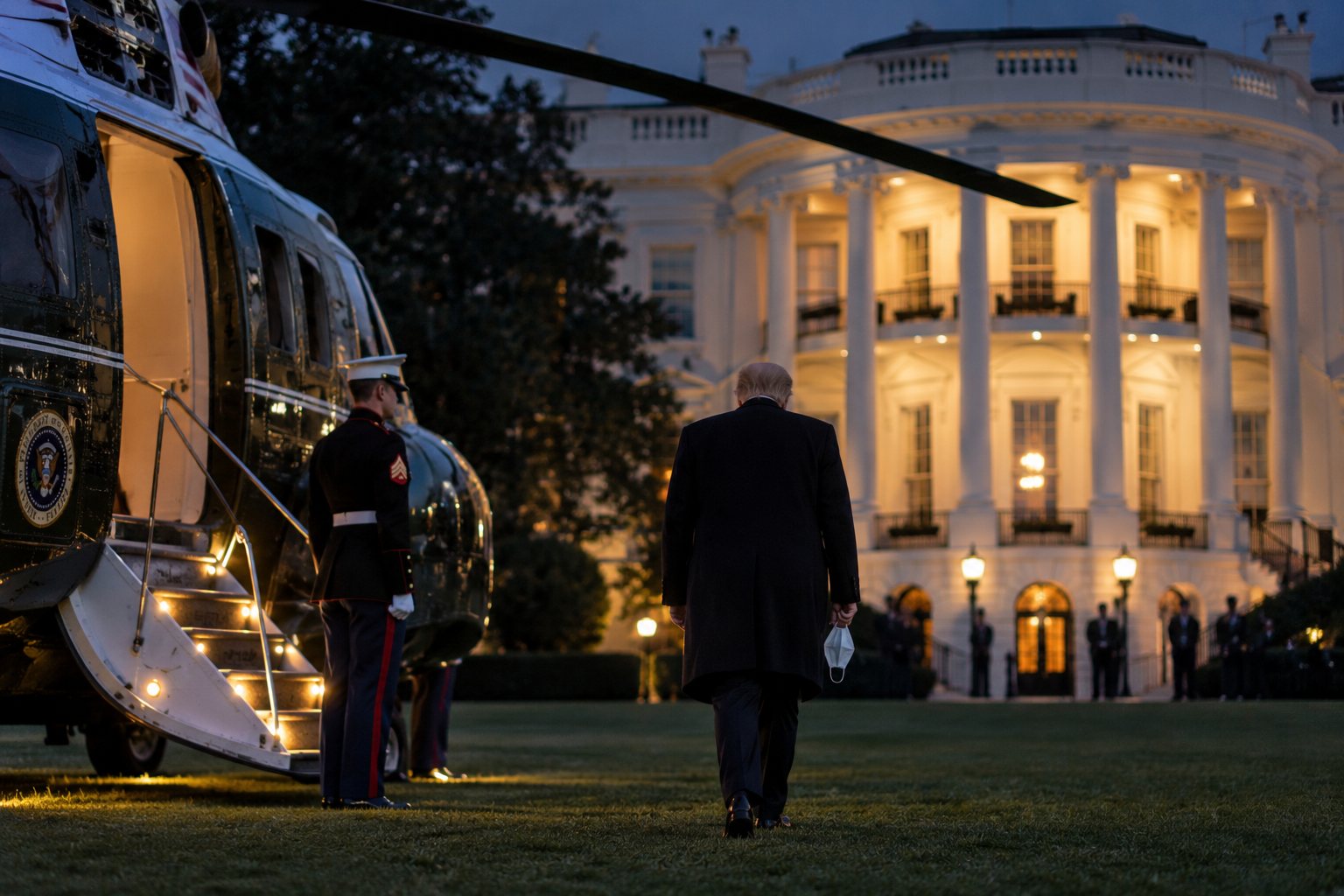
On October 5, Trump left Walter Reed.
He boarded Marine One and returned to the White House.
Then came one of the defining images of his experience with COVID.
Trump climbed the stairs to the White House balcony, turned toward the cameras and removed his mask.
He posed for photographs and gave a thumbs-up.
Soon afterward, Trump released a video telling Americans:
“Don't be afraid of Covid.”
He urged people not to allow the virus to dominate their lives.
The message was unmistakable.
Trump wanted his recovery to project strength.
But the circumstances surrounding that message were extraordinary.
The president had just spent nearly three days in one of the nation's premier military hospitals.
He had received supplemental oxygen.
He had received an antiviral medication.
He had received a steroid used for patients with significant COVID illness.
And he had received an experimental antibody treatment unavailable to most Americans.
Millions of ordinary Americans infected with COVID did not have a presidential medical unit, immediate helicopter transportation to Walter Reed or access to experimental treatments.
Many never came home from the hospital at all.
October 6: “No Symptoms”
The next morning, October 6, Trump's physician released another update.
Conley said the president had experienced a restful first night back at the White House and reported no symptoms.
His vital signs were described as stable.
Trump himself announced that he was “FEELING GREAT!”
He was already talking about returning to the campaign trail and participating in the next presidential debate.
But his treatment was not finished, and doctors were still monitoring him.
Conley had acknowledged only a day earlier that Trump's doctors were not yet completely certain that he was out of danger.
COVID patients could improve and then deteriorate.
The president was recovering.
He was not yet simply another healthy man returning to work.
The Virus Trump Had Downplayed Reached His Own White House
Trump's infection also wasn't occurring in isolation.
COVID was spreading through his political and governmental circle.
First Lady Melania Trump tested positive.
White House Press Secretary Kayleigh McEnany tested positive.
Senior adviser Hope Hicks tested positive.
Former adviser Kellyanne Conway tested positive.
Trump campaign manager Bill Stepien tested positive.
Republican National Committee Chairwoman Ronna McDaniel tested positive.
Several Republican senators tested positive.
Former New Jersey Governor Chris Christie became seriously ill and was hospitalized.
Many of those infected had attended a September 26 White House Rose Garden ceremony announcing Amy Coney Barrett's Supreme Court nomination, where masks and physical distancing were often absent.
The pandemic had reached directly into the center of American political power.
Months of Downplaying the Danger
Trump's illness carried particular significance because of how he had discussed COVID throughout 2020.
Early in the pandemic, he repeatedly suggested that the virus would disappear.
In February, he said that one day it could disappear “like a miracle.”
He frequently pushed for rapid reopening of businesses and schools.
He resisted consistently modeling mask use in public and sometimes mocked political opponents for wearing them.
Most significantly, journalist Bob Woodward had released recorded interviews in September in which Trump acknowledged that he understood COVID was dangerous early in the pandemic.
Trump told Woodward in February that the virus was airborne and considerably more deadly than ordinary influenza.
In another recorded conversation in March, Trump said he wanted to “play it down.”
Trump later defended his approach by saying he did not want to create panic.
By October, however, the contrast had become impossible to overlook.
The president who had publicly minimized the threat was now receiving hospital-level treatment for the very disease he had repeatedly tried to reassure Americans about.
A Different Experience From Most Americans
There was another important distinction.
Trump survived his encounter with COVID with resources unavailable to almost everyone else.
A team of physicians monitored him around the clock.
Marine One transported him to Walter Reed.
Specialists were immediately available.
He received multiple advanced therapies, including an experimental antibody treatment.
That was the context in which the president told Americans:
“Don't be afraid of Covid.”
For families who had watched loved ones become critically ill, who couldn't accompany them into hospitals because of infection-control restrictions, or who had already buried someone killed by the disease, Trump's message landed very differently.
More than 200,000 Americans were already dead.
Millions had been infected.
And thousands more would die in the months ahead.
October 6, 2020
On this day in 2020, Donald Trump was back at the White House and reporting no COVID symptoms.
His doctors described his condition as improving.
But the larger story was difficult to miss.
For months, Trump had tried to convince Americans that the virus was under control and that they should not allow fear of COVID to dictate their lives.
Then COVID entered the White House.
It infected members of Trump's family, administration, campaign and political circle.
And eventually it infected the president himself.
Trump didn't simply test positive.
He became sick enough to be hospitalized, experience oxygen drops and receive an aggressive combination of treatments.
The pandemic Trump had repeatedly tried to minimize had reached the most protected man in America.
And on October 6, even as he continued recovering from it, Donald Trump was still telling the country not to be afraid.