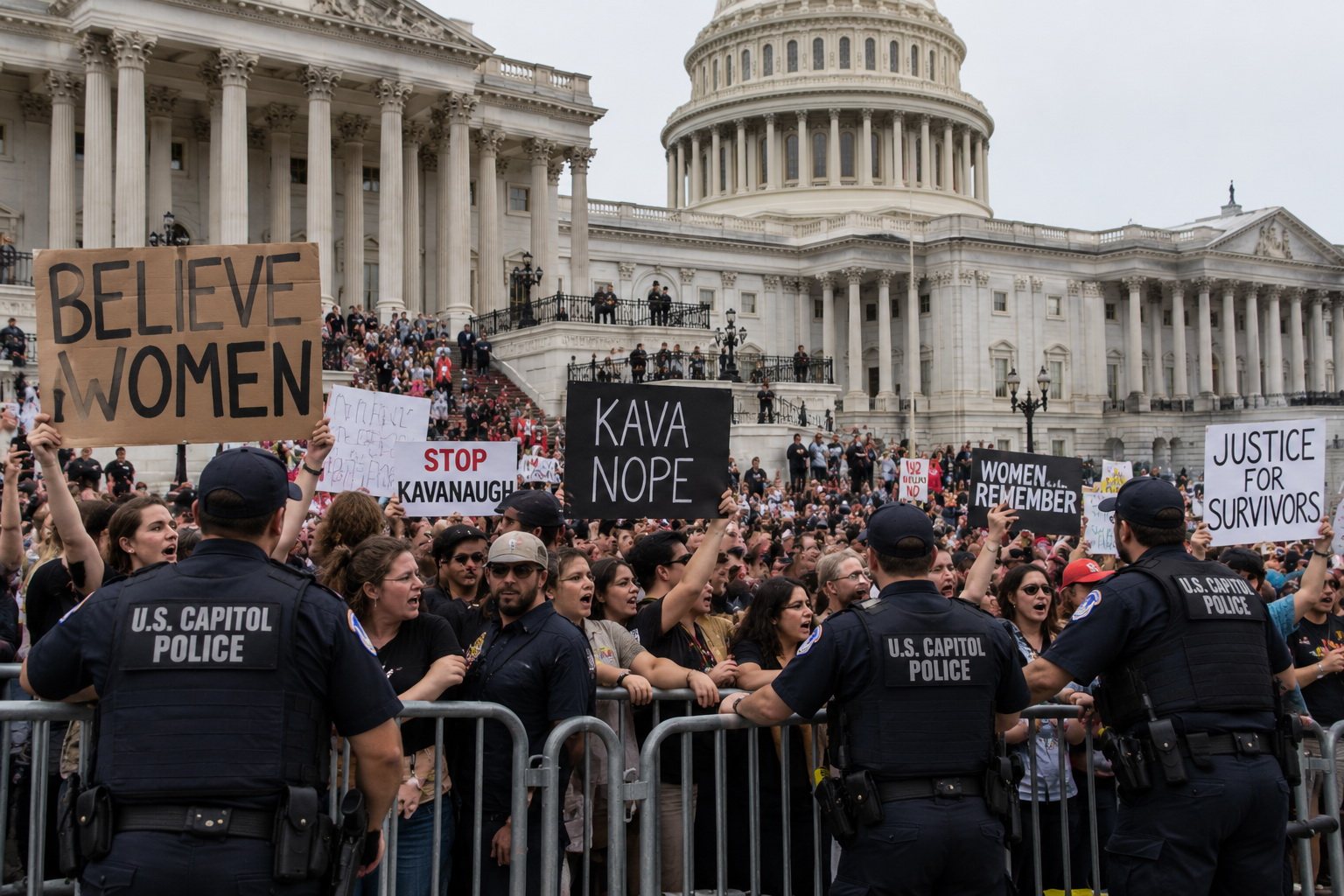
One week after the Senate confirmed Brett Kavanaugh to the Supreme Court following explosive allegations of sexual assault and an intensely partisan confirmation battle, President Donald Trump traveled to Kentucky and turned the controversy into a midterm campaign weapon. Trump praised Senate Majority Leader Mitch McConnell for standing up to what he called an “angry left-wing mob” and told voters that the upcoming election offered a choice between Democratic “mob rule” and Republican “law and order.”**
The fight over Brett Kavanaugh was over.
The political fight over what had happened was just beginning.
On October 13, 2018, Donald Trump arrived at Eastern Kentucky University in Richmond, Kentucky, for a campaign rally supporting Republican Rep. Andy Barr.
The midterm elections were only 24 days away.
And Trump had a new message for Republican voters.
Democrats weren't merely the opposition party.
They were a “mob.”
The Kavanaugh Battle
Trump nominated Brett Kavanaugh to the Supreme Court in July 2018 to replace retiring Justice Anthony Kennedy.
Then the confirmation process exploded.
Christine Blasey Ford publicly accused Kavanaugh of sexually assaulting her when they were teenagers in the early 1980s.
Kavanaugh denied the allegation.
Ford and Kavanaugh both appeared before the Senate Judiciary Committee in an extraordinary nationally televised hearing on September 27.
Ford testified that she was “100 percent” certain Kavanaugh had assaulted her.
Kavanaugh angrily denied it.
Other allegations against Kavanaugh also surfaced, which he denied.
The FBI conducted a supplemental background investigation requested by the Senate, although Democrats criticized its scope and argued that potentially relevant witnesses had not been interviewed.
On October 6, the Senate confirmed Kavanaugh by a vote of 50–48.
He was sworn in that day.
The confirmation fight had deeply divided the country.
Trump saw an opportunity.
“The Angry Left-Wing Mob”
Standing before supporters in Kentucky a week later, Trump praised Kavanaugh and condemned the Democrats who had opposed him.
“What the crazy, radical Democrats did to Justice Kavanaugh is a national disgrace,” Trump said.
He accused Democrats of attempting to “obstruct, resist, delay, demolish, and destroy.”
Then Trump turned his attention to Kentucky's own Mitch McConnell.
McConnell, Trump said, had refused to surrender during the confirmation fight.
“He stared down the angry left-wing mob,” Trump declared.
“He never blinked, and he never looked back.”
Trump brought McConnell onto the stage.
McConnell reminded the crowd that Republicans had already confirmed dozens of federal judges under Trump and promised:
“Keep sending them our way and we'll keep confirming them and change the court system forever.”
It was one of the clearest descriptions of what was at stake.
Kavanaugh wasn't an isolated appointment.
Trump and McConnell were reshaping the federal judiciary.
“Democrat Mob Rule”
Trump then broadened the attack beyond the senators who had opposed Kavanaugh.
He turned the upcoming election into a choice between two versions of America.
“On this Election Day, November 6th, every American faces a simple choice,” Trump said.
Then came the line:
> “You can either vote for Democrat mob rule or you can vote for a Republican Party that stands proudly for law and order, fairness, freedom, and justice.”
It wasn't an accidental phrase.
Trump and Republicans had increasingly adopted the word “mob” as a campaign theme following the Kavanaugh confrontation.
Protests against the nomination had occurred throughout Washington.
Demonstrators confronted senators in Capitol hallways.
Protesters gathered outside offices and homes.
Some interrupted Senate proceedings and were removed from the galleries.
There were also confrontational incidents involving Republican politicians outside the Capitol.
Republicans seized on those scenes.
Rather than distinguish among peaceful protesters, disruptive protesters, Democratic politicians and millions of Democratic voters, Trump's rhetoric increasingly placed them within a broader political category:
The mob.
The Allegations Became a Republican Rallying Cry
Trump's portrayal of Kavanaugh was equally sweeping.
He told the Kentucky crowd that Kavanaugh had been treated terribly and called him a “great, great gentleman.”
Trump portrayed the allegations and confirmation battle as an organized Democratic attempt at political destruction.
But Ford's allegation wasn't simply something Democratic senators had invented.
Ford had contacted her congressional representative before Kavanaugh's nomination was publicly announced and later communicated with Sen. Dianne Feinstein.
Ford ultimately testified publicly under oath.
Kavanaugh testified under oath as well and unequivocally denied assaulting her.
The Senate confirmed him.
None of that required voters to accept Trump's broader claim that opposition to Kavanaugh constituted mob behavior.
Protest Became “Mob Rule”
The language mattered because political protest is not the same thing as mob rule.
Americans have a constitutional right to assemble, demonstrate and petition their government.
That doesn't protect violence, threats or unlawful conduct.
But neither does disruptive behavior by some protesters transform an entire political party into a mob.
Trump blurred those distinctions.
The rhetoric allowed him to take one of the most divisive political events of 2018 and convert it into something much simpler:
Republicans represented order.
Democrats represented chaos.
Kavanaugh represented an innocent man rescued from political destruction.
McConnell represented strength.
And Trump represented the leader who had fought alongside them.
A Midterm Strategy Takes Shape
The Richmond rally wasn't an isolated appearance.
Trump was traveling aggressively for Republican candidates as the November elections approached.
Kavanaugh had become one of his favorite subjects.
The president increasingly grouped the Supreme Court fight together with immigration, border security and “law and order” as reasons voters should keep Republicans in control of Congress.
The message was designed to energize Republicans who had watched the Kavanaugh hearings with anger.
Democrats were attempting to use the same confrontation to motivate their voters, particularly women outraged by the handling of Ford's allegation.
Both sides understood that the Supreme Court fight had become bigger than Brett Kavanaugh.
It was now part of the election.
The Court Was Changing
Behind all of Trump's rhetoric was something much more consequential than a campaign slogan.
The federal judiciary was being transformed.
Kavanaugh was Trump's second Supreme Court appointment after Neil Gorsuch.
McConnell had also made judicial confirmations one of the Senate's highest priorities.
At the October 13 rally, Trump boasted about the number of judges Republicans had confirmed.
McConnell openly told the crowd they could “change the court system forever.”
That prediction proved consequential.
Two years later, Trump would appoint a third Supreme Court justice, Amy Coney Barrett.
The resulting conservative majority would subsequently issue decisions affecting abortion, firearms, environmental regulation, affirmative action, presidential power and the authority of federal agencies.
The political battle surrounding the courts did not end with Kavanaugh's confirmation.
It intensified.
From Political Opposition to “The Enemy”
October 13, 2018 also provides an important snapshot of Trump's political language.
That evening, Democrats weren't simply wrong.
They weren't merely liberal.
They weren't simply political opponents.
They were an “angry left-wing mob.”
And voters were told that electing Democrats meant choosing “mob rule.”
It was an increasingly stark way of describing political opposition: one side representing order and the other representing danger.
Years later, Trump's language about domestic political opponents would become even stronger.
But in Richmond, Kentucky, on October 13, 2018, the pattern was already plainly visible.
A bitter Supreme Court confirmation fight had ended.
Trump immediately turned it into the next campaign battle.