Donald Trump's first attempt to restrict travel from several predominantly Muslim countries had produced chaos at airports, widespread protests and a major defeat in federal court.
Rather than continue defending that original order, the Trump administration replaced it.
On March 6, Trump signed Executive Order 13780 — a substantially revised version of the immigration restrictions he had imposed just weeks earlier.
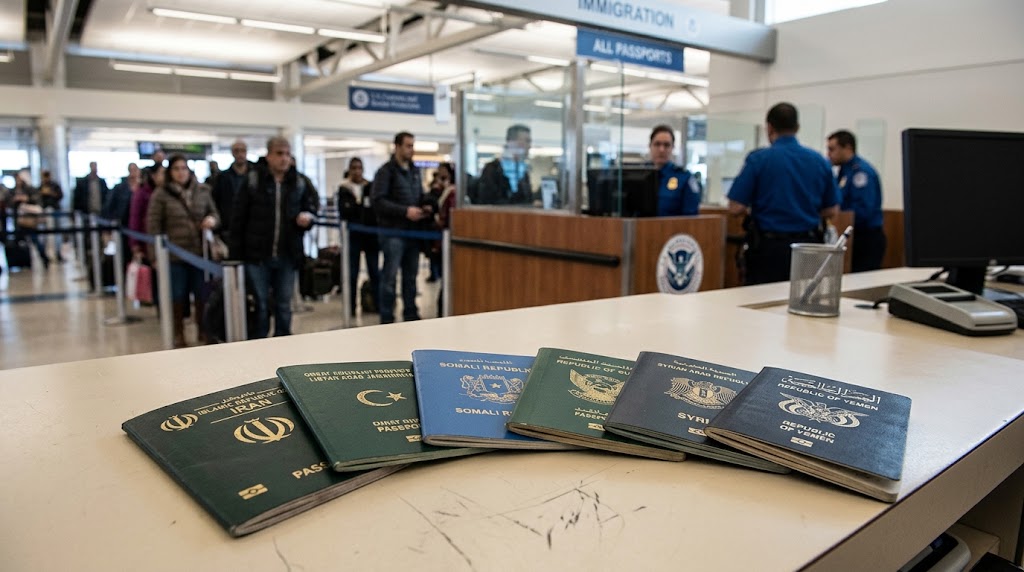
The new order suspended entry for 90 days for certain nationals of six countries:
Iran, Libya, Somalia, Sudan, Syria and Yemen.
Iraq, which had been included in Trump's original seven-country order, was removed from the list.
The administration had changed the details.
But the central policy remained: temporarily preventing broad categories of people from designated countries from entering the United States while the government reviewed its screening and vetting procedures.
The First Order Had Run Into the Courts
Trump's original January 27 executive order had taken effect almost immediately.
The result was confusion at airports as travelers who had already been approved to enter the United States suddenly found themselves caught by the new restrictions.
Legal challenges followed.
On February 3, federal Judge James Robart temporarily blocked significant portions of the order nationwide.
The Trump administration asked the Ninth Circuit Court of Appeals to restore the restrictions.
It refused.
A three-judge panel unanimously declined to stay Robart's order while the litigation continued.
Instead of taking that version of the travel ban further through the courts, the administration decided to replace it.
Travel Ban 2.0
The March 6 order contained several significant changes.
Iraq disappeared from the list of restricted countries.
The administration said the Iraqi government had agreed to improve cooperation and information sharing with the United States and pointed to the country's partnership with the United States in fighting ISIS.
The new order also explicitly excluded lawful permanent residents — green-card holders — from the suspension.
People who possessed valid visas were generally not subjected to the new restrictions merely because of the order.
The administration also eliminated one of the most controversial distinctions contained in the original order involving religious minorities seeking refugee status.
And Syrian refugees were no longer subjected to the original order's indefinite suspension.
Instead, the revised order suspended the broader U.S. refugee admissions program for 120 days.
The new restrictions were also scheduled to take effect on March 16 rather than immediately.
The changes addressed several of the practical and legal problems that had surrounded Trump's first order.
The Administration's National-Security Argument
The Trump administration maintained that the restrictions were necessary for national security.
The March order said the government needed time to review the information countries supplied about their nationals and determine whether existing screening procedures were adequate.
The six countries, the administration argued, presented heightened concerns because of terrorism, instability or deficiencies in information sharing.
The 90-day suspension would provide the government time to conduct that review.
Supporters therefore viewed the revised order as a legitimate exercise of presidential authority over immigration and national security.
Critics remained unconvinced.
The Religious-Discrimination Question Didn't Disappear
Changing the wording of the order did not eliminate the controversy surrounding Trump's earlier statements about Muslim immigration.
During the 2016 campaign, Trump had publicly called for what his campaign described as a “total and complete shutdown of Muslims entering the United States.”
After becoming president, the administration framed its policy around nationality and national security rather than religion.
The revised order itself explicitly stated that the January order had not been motivated by hostility toward any religion.
But opponents argued that Trump's previous statements remained relevant when determining the purpose behind the policy.
That question would soon return to federal court.
Back to Court
The revised order was supposed to take effect on March 16.
It didn't happen as planned.
On March 15 — one day before implementation — a federal judge in Hawaii temporarily blocked key provisions of the new order.
A federal judge in Maryland separately blocked enforcement of the provision suspending entry of nationals from the six designated countries.
Trump's attempt to rewrite the policy had therefore addressed some of the problems with the first order, but it had not ended the legal battle.
The administration would spend much of the following year defending successive versions of Trump's travel restrictions.
The dispute ultimately reached the Supreme Court.
In 2018, the Court upheld a later presidential proclamation containing materially different country-specific restrictions.
A Policy Rewritten Under Legal Pressure
The March 6 order illustrated something important about the opening weeks of the Trump presidency.
The administration's original travel order had encountered immediate practical problems and serious legal challenges.
After losing its effort to have the first order quickly restored, the administration didn't simply abandon the policy.
It rewrote it.
Iraq was removed.
Green-card holders were explicitly protected.
Existing visas received clearer treatment.
The indefinite suspension involving Syrian refugees disappeared.
Implementation was delayed.
Those changes made the second order meaningfully different from the first.
But they did not end the underlying dispute over presidential authority, immigration, national security and religious discrimination.
Just over five weeks after issuing his original travel ban, Trump was trying again.
And once again, the federal courts were about to have the next word.