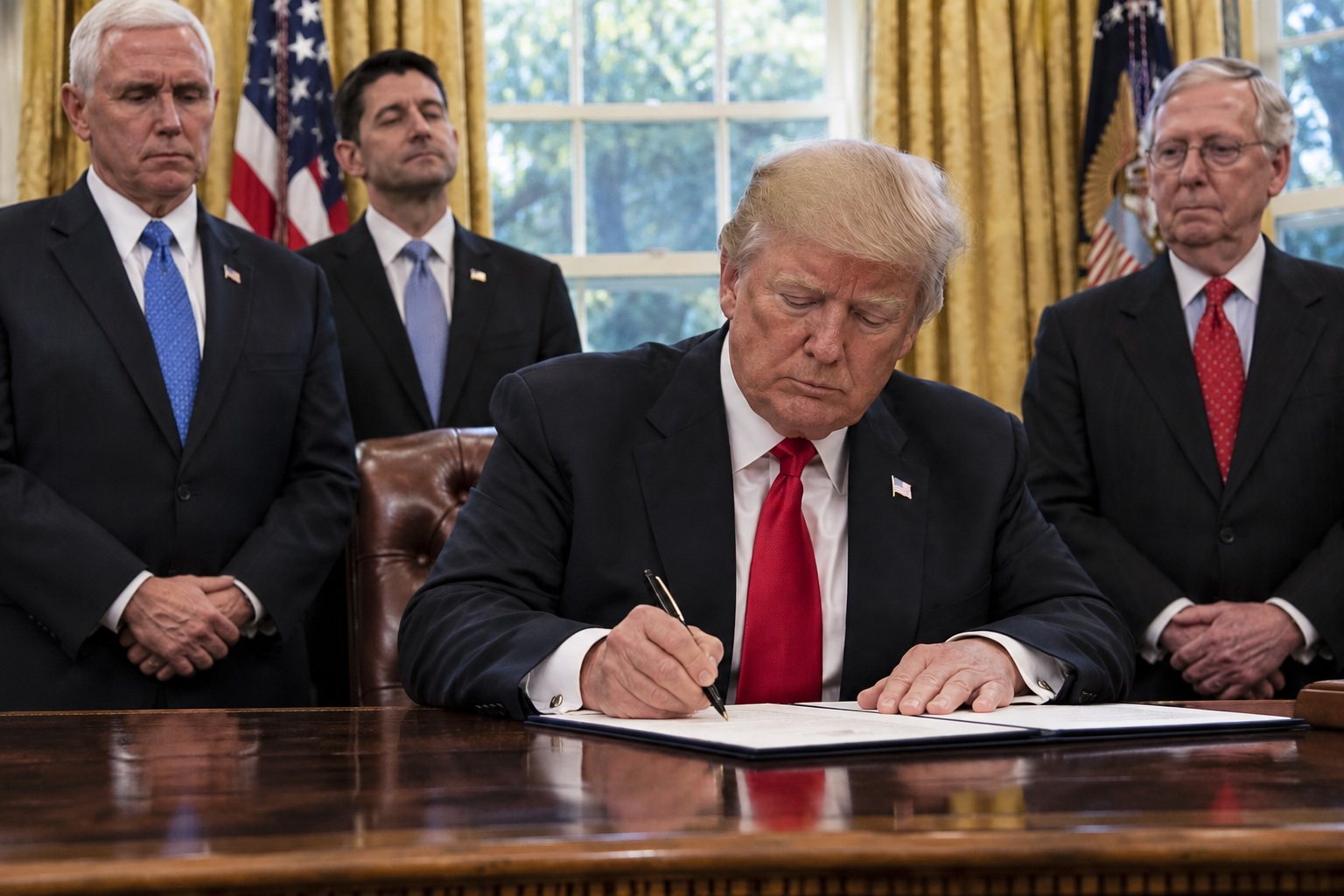
After Republicans repeatedly failed to repeal the Affordable Care Act through Congress, President Donald Trump turned to executive power, signing an order designed to expand insurance alternatives that could operate outside some of Obamacare's protections. The same day, his administration announced it would stop billions of dollars in payments that helped insurers reduce deductibles and other out-of-pocket costs for lower-income Americans.**
For much of 2017, Donald Trump and congressional Republicans had promised to repeal and replace the Affordable Care Act.
They controlled the White House, House and Senate.
Yet their repeal effort repeatedly collapsed.
The House narrowly passed its repeal legislation in May, but Senate Republicans were unable to agree on a replacement. Their most dramatic defeat came in July, when Sen. John McCain joined Republican Sens. Susan Collins and Lisa Murkowski in voting against the so-called “skinny repeal.”
Another Republican repeal proposal collapsed in September.
Obamacare survived.
But the Trump administration wasn't finished.
If Congress Wouldn't Do It, Trump Would Use Executive Power
On October 12, Trump signed an executive order titled “Promoting Healthcare Choice and Competition Across the United States.”
The order directed federal agencies to pursue three major changes: expanding association health plans, expanding short-term limited-duration insurance, and broadening the use of health reimbursement arrangements.
Trump presented the move as giving Americans more choices and less expensive insurance.
There was another side to those cheaper alternatives.
Some plans operating under different rules could offer fewer benefits and fewer protections than comprehensive ACA-regulated individual-market coverage.
The American Hospital Association warned that the executive order could allow plans covering fewer benefits with fewer consumer protections and could destabilize the individual and small-group insurance markets.
The concern was straightforward.
Healthier people might leave the ACA-regulated market for cheaper, less comprehensive plans. People who were older, sick or needed more extensive coverage would be more likely to remain.
That could make the remaining insurance pool more expensive.
Then Came Another Blow
The executive order wasn't the only major Obamacare action that day.
The Trump administration also announced that it would stop making cost-sharing reduction payments, commonly called CSR payments, to insurance companies.
Those payments compensated insurers for reducing deductibles, copayments and other out-of-pocket expenses for qualifying lower-income ACA customers.
Importantly, insurers were still legally required to provide those reductions.
Trump was eliminating the federal reimbursements that helped pay for them.
The Congressional Budget Office had already studied what would happen if the government stopped making the payments.
Its conclusion was striking.
CBO estimated that premiums for benchmark silver plans would be roughly 20 percent higher in 2018 and 25 percent higher by 2020 than they would have been if the payments continued.
The move wasn't even projected to save the federal government money over the long term.
Because ACA premium tax credits generally rise when benchmark premiums rise, CBO estimated that ending the payments would ultimately increase federal deficits by $194 billion between 2017 and 2026.
Some subsidized customers would be largely protected from the premium increases because their tax credits would increase.
People who didn't qualify for sufficient subsidies could face the increases much more directly.
These Weren't Abstract Policy Changes
Health insurance debates in Washington are often reduced to phrases such as “market competition,” “consumer choice,” “mandates” and “regulatory reform.”
But behind every insurance-market change are actual people trying to keep themselves and their families covered.
People bought ACA plans because they needed access to doctors, prescriptions, emergency treatment and protection against catastrophic medical bills.
Some depended on the law's protections for preexisting conditions.
Some depended on its subsidies.
Others earned too much to qualify for substantial assistance and had to absorb premium increases themselves.
For people caught in those gaps, losing affordable coverage wasn't a political talking point.
It meant becoming uninsured.
The Administration Said It Was Expanding Choice
Trump's administration argued that Obamacare had left many consumers facing high premiums and too few insurers.
The October 12 executive order explicitly said its goal was to increase competition and expand access to less expensive alternatives.
Supporters argued that association plans could allow small businesses to band together and obtain insurance more like large employers, while short-term policies could provide cheaper options for people who didn't need or couldn't afford comprehensive ACA coverage.
Those arguments were real.
So were the risks.
Short-term insurance could cost less precisely because it didn't necessarily provide the same benefits or protections as ACA-compliant insurance.
That distinction matters enormously when someone actually gets sick.
Obamacare Survived — But the Fight Changed
Trump never achieved the sweeping legislative repeal of Obamacare that Republicans had promised.
Instead, his administration began changing the healthcare system through executive and regulatory actions.
October 12, 2017 became an important moment in that effort.
After Congress failed to dismantle the Affordable Care Act legislatively, Trump signed an executive order opening the door to insurance alternatives outside portions of the ACA framework.
Then his administration stopped the cost-sharing payments supporting the ACA marketplaces.
For Washington, these were policy decisions.
For Americans whose premiums increased, whose insurance options changed, or who could no longer find coverage they could afford, the consequences were much more personal.
Some people didn't merely watch the fight over Obamacare on television.
They lost their healthcare.