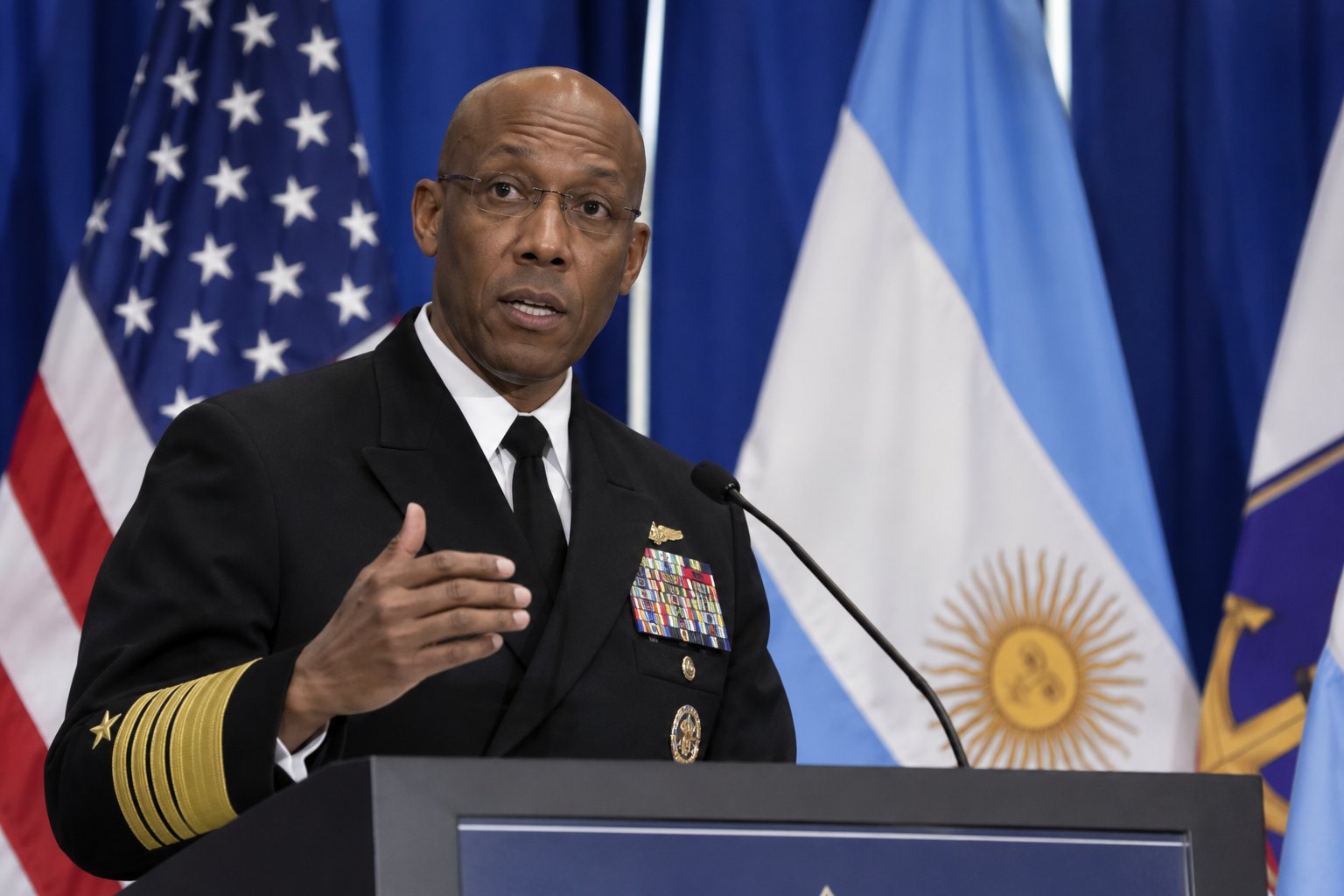
The U.S. Navy admiral responsible for American military operations across Latin America and the Caribbean announced an unexpected early retirement on October 16, 2025, just as President Donald Trump's administration was expanding a controversial campaign of lethal strikes against boats suspected of transporting illegal drugs.
Admiral Alvin Holsey, commander of U.S. Southern Command, announced that he would retire on December 12 after more than 37 years of military service.
The announcement was unusual for a senior combatant commander.
Holsey had assumed command in November 2024, meaning he would leave after barely 13 months in a position that typically carries a three-year assignment.
His departure came during one of the most consequential periods for Southern Command in years.
American warships and aircraft were operating near Venezuela, U.S. forces had carried out five publicly announced deadly strikes against suspected drug-smuggling vessels, and the Trump administration was asserting that it possessed the authority to use military force against alleged narcotics traffickers.
At least 27 people had been killed in the strikes by the time Holsey's departure was announced.
The administration did not publicly explain why the admiral was leaving so early.
But the timing, combined with reports of friction between Holsey and Defense Secretary Pete Hegseth, immediately raised questions about the Pentagon's leadership and the administration's increasingly aggressive military operations in the Caribbean.
An Unexpected Departure From One of America's Most Important Military Commands
Holsey was not a junior officer or an administrator nearing the end of a routine assignment.
He was a four-star Navy admiral overseeing one of the United States military's major geographic combatant commands.
U.S. Southern Command, headquartered in Doral, Florida, is responsible for military operations and security cooperation across much of Central America, South America, and the Caribbean.
Its responsibilities include counter-narcotics operations, maritime security, military partnerships, and responses to regional crises.
Holsey had taken command on November 7, 2024, succeeding Army General Laura Richardson.
He previously served as Southern Command's military deputy commander, giving him extensive familiarity with the region and its operational responsibilities.
Ordinarily, a combatant commander remains in the position for approximately three years.
Holsey's announced departure would cut that expected tenure dramatically short.
Defense Secretary Hegseth confirmed the retirement in a public statement praising the admiral's decades of service.
He described Holsey's career as one of operational excellence and strategic leadership.
Holsey also issued a statement expressing gratitude for the opportunity to serve.
Neither man publicly provided a specific explanation for the early departure.
Reports of Tension Between Holsey and Hegseth
Although the official statements were complimentary, news organizations reported that the relationship between the admiral and the defense secretary had become strained.
Reuters reported on October 16 that a source familiar with the matter described tensions between Holsey and Hegseth over military operations in the Caribbean.
According to that reporting, questions had circulated in the days before the announcement about whether Holsey might be removed from his position.
The Washington Post separately reported that two people familiar with the situation said Hegseth had become dissatisfied with Holsey and wanted him to step aside.
Those accounts suggested that the retirement announcement might have followed disagreements within the Pentagon.
However, an important distinction remained.
The existence of reported tensions did not establish that Holsey had opposed the boat strikes on legal, moral, or operational grounds.
Nor did the public reporting establish that he had refused an order.
Holsey himself did not publicly identify any disagreement with the administration as the reason for his retirement.
The precise circumstances behind his departure therefore remained unresolved on October 16.
Five Deadly Boat Strikes and 27 People Killed
The admiral's announcement came just two days after Trump disclosed another deadly American attack on a small vessel in the Caribbean.
On October 14, the president said U.S. forces had destroyed a boat suspected of transporting illegal narcotics, killing six people aboard.
It was the fifth publicly announced strike in a campaign that began in September.
Together, the attacks had reportedly killed 27 people.
The administration described the people aboard the targeted vessels as narcoterrorists associated with criminal organizations.
Trump and Hegseth argued that the operations were necessary to combat trafficking networks responsible for bringing deadly drugs into the United States.
But the administration had not publicly released sufficient evidence to independently verify the identities of those killed, the contents of the targeted boats, or the intelligence supporting each strike.
The operations also differed substantially from traditional American maritime drug enforcement.
Historically, suspected trafficking vessels have been intercepted by the Coast Guard or other authorized law enforcement personnel.
Such operations can involve boarding vessels, searching for contraband, seizing drugs, arresting suspects, and pursuing criminal prosecutions.
The Trump administration's campaign instead involved lethal military attacks that destroyed vessels and killed their occupants.
That shift generated significant legal and congressional scrutiny.
The Legal Controversy Surrounding the Strikes
The administration maintained that it was engaged in an armed conflict with certain drug trafficking organizations.
Under that theory, people identified as members of those organizations could be treated as enemy combatants and targeted with military force.
The legal argument was controversial.
Drug trafficking is ordinarily treated as a criminal offense, even when it involves organized groups responsible for serious violence.
International humanitarian law permits military targeting in armed conflicts under defined conditions.
But the existence of a criminal organization does not automatically establish an armed conflict or make every suspected member a lawful military target.
Legal specialists questioned whether the administration had demonstrated that the conditions necessary to invoke the laws of war existed.
Others raised concerns about the absence of publicly disclosed evidence connecting the targeted individuals to specific organizations or hostile activities.
The administration rejected the suggestion that its actions were unlawful and maintained that it possessed the necessary intelligence and military authority.
As commander of Southern Command, Holsey occupied a position directly connected to the region in which these operations were taking place.
That made his abrupt departure especially noteworthy.
It did not, however, prove that he disagreed with the legal justification for the strikes.
Pentagon Shifts Counter-Narcotics Leadership to a Marine Corps Force
Another development added to questions about the administration's military command arrangements.
Less than a week before Holsey's retirement announcement, the Pentagon had assigned a leading role in regional counter-narcotics operations to II Marine Expeditionary Force, based at Camp Lejeune, North Carolina.
The decision attracted attention because Southern Command would ordinarily be expected to play a central role in major military operations within its geographic area of responsibility.
II Marine Expeditionary Force is a substantial Marine Corps formation capable of conducting expeditionary combat operations.
Its involvement did not, by itself, establish that Southern Command had been sidelined or that Holsey had lost the administration's confidence.
Military commands routinely establish specialized task forces and assign operational responsibilities across different headquarters.
Nevertheless, the unusual arrangement, combined with the commander's unexpected departure, prompted questions about who was directing the campaign and how its military objectives were being defined.
A Growing American Military Buildup Near Venezuela
By mid-October, the United States had assembled a substantial military presence in the Caribbean.
American naval forces included guided-missile destroyers and amphibious ships, supported by aircraft and thousands of military personnel.
Reuters reported that the regional buildup included F-35 fighter aircraft and a nuclear-powered submarine.
The administration said the deployments supported operations against drug trafficking organizations.
But they also occurred during rapidly escalating tensions with Venezuelan President Nicolás Maduro.
Washington had accused Maduro and other Venezuelan officials of involvement in international narcotics trafficking.
Maduro denied those allegations and accused the United States of using counter-narcotics operations as a pretext for threatening his government.
On October 15, Trump publicly acknowledged authorizing covert CIA operations involving Venezuela.
That announcement intensified speculation about whether American operations could expand beyond maritime strikes.
The military buildup therefore raised questions extending beyond drug interdiction.
Lawmakers and analysts were increasingly concerned about the possibility of a wider confrontation involving Venezuela.
Senator Jack Reed Raises Concerns
The announcement drew a particularly critical response from Senator Jack Reed of Rhode Island, the senior Democrat on the Senate Armed Services Committee.
Reed described Holsey's unexpected departure as troubling.
He warned that the administration might be disregarding the experience and judgment of senior military leaders.
His concerns reflected a broader debate over the Pentagon's leadership under Hegseth.
Since taking office, Hegseth had overseen the departure or dismissal of several senior military officials.
Among them were General Charles Q. Brown Jr., who had served as chairman of the Joint Chiefs of Staff, and Admiral Lisa Franchetti, the Navy's chief of naval operations.
The administration defended its authority to select military leaders who would carry out its policies.
Presidents and defense secretaries possess broad powers to make senior military leadership changes, subject to applicable legal requirements.
But critics questioned whether the unusually high-profile departures were disrupting military continuity and discouraging disagreement within the chain of command.
Holsey's announcement added another senior officer to that growing list.
Who Was Admiral Alvin Holsey?
Holsey's career spanned more than three decades of Navy service.
A native of Fort Valley, Georgia, he received his commission in 1988 through the Naval Reserve Officers Training Corps program at Morehouse College.
He became a naval aviator and flew helicopters, including the SH-2F Seasprite and SH-60B Seahawk.
Over the course of his career, he held major operational leadership assignments.
He commanded a helicopter anti-submarine squadron and the amphibious assault ship USS Makin Island.
He later commanded Carrier Strike Group One, associated with the aircraft carrier USS Carl Vinson.
Before taking charge of Southern Command, he served as its military deputy commander.
His background combined aviation, naval command, carrier operations, and regional military leadership.
At the time of the announcement, he was one of a small number of Black four-star officers leading American combatant commands.
His retirement would end a career that began during the final years of the Cold War and extended through decades of changing American military operations.
The Question of Military Advice and Presidential Authority
The controversy surrounding Holsey's departure highlighted a recurring issue in American civil-military relations.
Civilian officials, including the president and secretary of defense, possess constitutional and statutory authority over the armed forces.
Senior military commanders are responsible for providing professional advice, assessing operational risks, and executing lawful orders.
Disagreement between civilian and military leaders is not inherently improper.
Military officers are expected to provide candid assessments, including warnings about legal, strategic, and operational consequences.
At the same time, commanders do not possess independent authority to disregard lawful policy decisions simply because they disagree with them.
The system depends on both civilian control and professional military judgment.
When a senior commander leaves unexpectedly during a controversial operation, questions about that relationship naturally arise.
But determining whether a departure reflects ordinary retirement, policy disagreement, a leadership dispute, or another circumstance requires evidence.
On October 16, the administration had not provided that explanation.
What Was Known — and What Remained Unanswered
Several facts about Holsey's departure were clear.
He had been in command for less than a year.
He planned to retire on December 12, 2025.
His departure was substantially earlier than the typical tenure for a combatant commander.
It occurred amid a major military buildup and a campaign of deadly strikes in the Caribbean.
And credible news organizations reported tensions between Holsey and Hegseth over regional operations.
But other questions remained unanswered.
Had Holsey expressed concerns about the legal basis for the strikes?
Had he disagreed with the administration's operational plans?
Was his departure voluntary, requested by senior civilian officials, or the result of a combination of factors?
Did the reassignment of counter-narcotics responsibilities reflect dissatisfaction with Southern Command?
None of those questions had been conclusively resolved by the public evidence available on October 16.
The timing warranted scrutiny, but it did not establish a specific motive.
An Admiral Leaves as the Military Campaign Expands
The significance of Holsey's announcement extended beyond the departure of a single military officer.
The United States was carrying out a campaign of lethal maritime strikes under a disputed legal theory.
The administration had not publicly disclosed the evidence supporting its accusations against the people killed.
American military forces were concentrating near Venezuela.
And the president had just confirmed authorization for covert CIA operations involving that country.
In the middle of those developments, the senior commander responsible for the region announced that he would leave his post years earlier than normally expected.
The administration thanked him for his service but offered no explanation for the timing.
On October 16, 2025, Admiral Alvin Holsey's early retirement became another unanswered question surrounding the Trump administration's expanding military campaign in the Caribbean.
His departure did not prove that he opposed the strikes.
But the combination of an abrupt leadership change, reported tensions inside the Pentagon, and an increasingly controversial military operation made the circumstances a legitimate matter for public and congressional scrutiny.
At a time when American forces were using lethal military power against suspected criminals at sea, questions about command responsibility, legal authority, and the treatment of senior military advice were especially consequential.