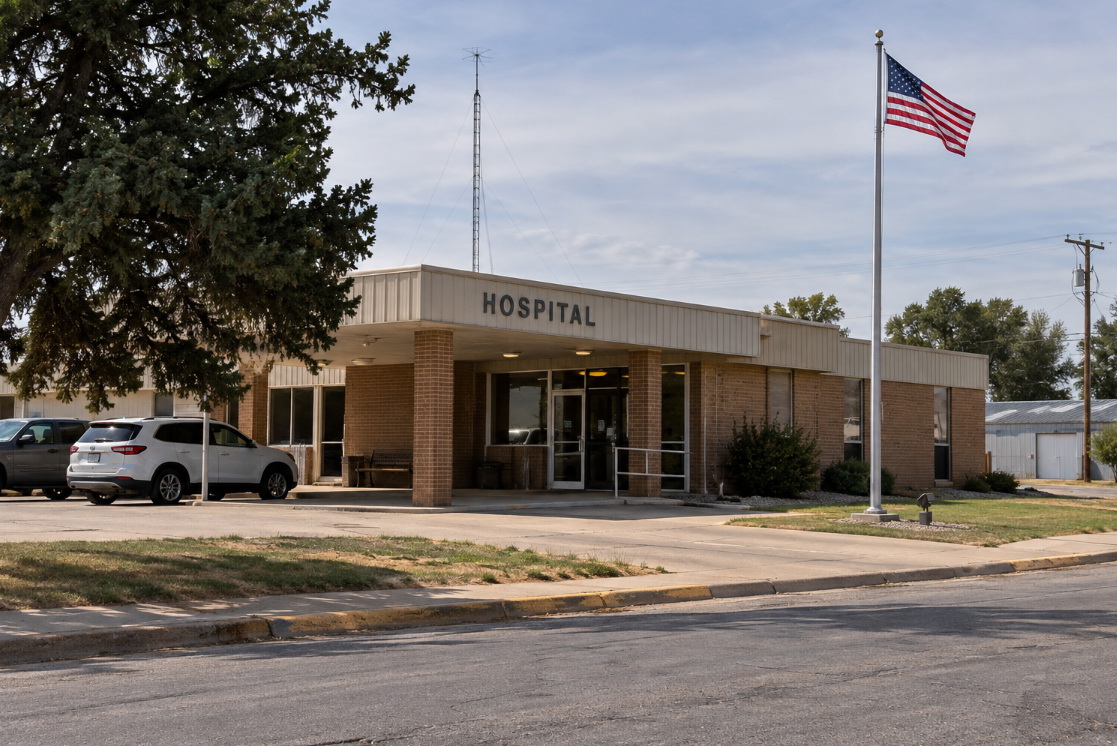
For more than 30 years, residents of this small rural Nebraska community could receive routine medical care without leaving town.
Then Curtis Medical Center closed.
The clinic served Curtis, the surrounding Frontier County community, and students attending the Nebraska College of Technical Agriculture. For a town of roughly 900 people, it was the only local general medical clinic.
Its operator, Community Hospital in McCook, announced in July 2025 that the facility could no longer remain open. The explanation pointed directly to a combination of rising costs, longstanding financial pressures and anticipated cuts to Medicaid funding from Washington.
“Unfortunately, the current financial environment, driven by anticipated federal budget cuts to Medicaid, has made it impossible for us to continue operating all of our services,” Community Hospital President and CEO Troy Bruntz said when announcing the closure.
The clinic ultimately shut its doors on September 30, 2025.
A Clinic Already on the Edge
Curtis Medical Center did not suddenly become financially troubled when Donald Trump returned to the White House.
Community Hospital acknowledged that some of its services had faced significant financial challenges for years. Its most recently available financial statement at the time showed the hospital organization had recorded a $1.67 million loss during the fiscal year ending June 2024.
That vulnerability is precisely what makes the Curtis story important.
Small rural health facilities often operate with little financial margin for error. They serve relatively small populations while still paying for medical professionals, equipment, buildings, insurance, utilities and other expenses necessary to keep a healthcare facility operating.
Inflation had already increased those costs.
Then came another source of uncertainty: federal Medicaid policy.
Medicaid Cuts Enter the Equation
When Community Hospital announced the Curtis closure, Congress was completing President Trump's sweeping tax-and-spending legislation containing major changes to Medicaid.
Hospital administrators did not wait for every provision to take effect before making their decision.
They had to plan for what they expected their finances to look like in the years ahead.
And Community Hospital's leadership explicitly said anticipated Medicaid reductions were part of that calculation.
Medicaid represented approximately $4.1 million — about 6 percent — of Community Hospital's patient-service revenue during its 2024 fiscal year.
For a large urban hospital system, losing a portion of one revenue stream might be something that can be absorbed.
For rural healthcare providers already operating near or below the break-even point, even the expectation of reduced reimbursement or fewer insured patients can change decisions about which facilities remain financially sustainable.
Curtis Medical Center became one of the earliest examples of that calculation.
The Trump Administration Didn't Create Rural Healthcare's Problems
Rural healthcare was struggling long before Trump returned to office.
That fact shouldn't be ignored.
Across the country, rural hospitals and clinics have dealt for years with declining populations, staffing shortages, aging patients, higher operating costs and reimbursement systems that often favor larger healthcare systems.
Curtis Medical Center itself had struggled financially for years.
But that is also why federal policy matters so much.
When a clinic is already hanging on by a thread, policymakers don't have to create the original problem to make it worse.
Community Hospital's leadership looked at the clinic's existing losses, continued inflation and the prospect of less Medicaid funding and concluded that keeping every service operating was no longer financially possible.
For Curtis, the result wasn't theoretical.
The town lost its clinic.
Forty Miles Becomes a Much Bigger Distance
For someone living in Omaha or Lincoln, losing a neighborhood doctor's office might mean driving several additional miles.
Rural Nebraska is different.
Curtis sits dozens of miles from larger medical centers. McCook, where Community Hospital operates, is roughly 40 miles away.
That distance matters when the patient is elderly.
It matters when someone doesn't drive.
It matters during a Nebraska winter.
It matters when a parent needs to take a child to the doctor but cannot afford to lose several additional hours of work.
And it matters when routine medical care is delayed until a manageable problem becomes an emergency.
The closure of a rural clinic therefore represents more than the disappearance of a building.
It changes how easily an entire community can obtain healthcare.
A Warning From Curtis
Supporters of Trump's legislation pointed to additional federal money intended to support rural healthcare providers, including a $50 billion rural health fund. Republican lawmakers argued that those provisions would help strengthen rural healthcare even as the broader legislation changed Medicaid spending.
But those assurances came too late to save Curtis Medical Center.
Community Hospital evaluated the financial future it saw ahead and decided the numbers no longer worked.
On September 30, 2025, a clinic that had served rural Nebraskans for more than three decades closed its doors.
Curtis is only one small town in Nebraska.
But its story illustrates the vulnerability of rural healthcare in America.
The clinic was already struggling. Inflation made operating it more expensive. Then anticipated reductions in federal Medicaid funding added another financial threat.
For policymakers in Washington, Medicaid can be discussed in billions of dollars, budget projections and ten-year spending windows.
In Curtis, Nebraska, the consequences were considerably easier to understand.
The town had one medical clinic.
Now it doesn't.